

Table of Contents
The International Monetary Fund (IMF) downgraded its global growth forecast to 3.1% and issued a recession warning in the event the US-Iran conflict worsens, and elevated oil prices persist until 2027.
After falling from a high of $126,000, Bitcoin has traded in a tight range between $60k and $70k last month.
But this week, the top token has picked up pace to trade under $74,000. However, the IMF's caution emphasises the precarious economic climate that can have a detrimental effect on digital assets.
As things continue to get worse, the IMF has warned that a worldwide recession is becoming more likely. The international body cited the ongoing crisis in Iran and the expectation that oil prices will continue over $100 until 2027 as a reason to reduce its growth prediction to 3.1% for 2026 from 3.4% earlier.
The IMF outlined three potential scenarios: mild, worse, and severe. The current pace of global expansion is reminiscent of rare situations, such as the economic crisis of 2009 or the pandemic in 2020, and could potentially decline to 2.0% in a dire scenario.
According to the IMF's definition of a recession, global growth is at or below 2.5%. Under this extreme scenario, the IMF's outlook indicates that inflation could reach over 6%, oil prices could average $110 per barrel this year and $125 in 2027, and gas prices in Europe and the US could surge by 200% or more.
According to IMF's chief economist Pierre-Olivier Gourinchas, the situation unfolding in the Gulf is "potentially much, much larger" than Trump’s tariff wave from a year ago, and that "downside risks clearly dominate the outlook right now."
According to Citadel CEO Ken Griffin, a recession is practically certain if the historic energy disruption lasts longer than six months.
JUST IN: Ken Griffin claims the world is “going to end up in a recession” if the Strait of Hormuz remains closed for 6-12 months.
— Polymarket (@Polymarket) April 14, 2026
Financial Stability Report Paints Gloomy Liquidity Picture
Separately, the international body's April 2026 Global Financial Stability Report assesses the increased risks to financial stability posed by the ongoing war in the Middle East.
The report highlights the possibility of multiple amplification channels that could undermine resilience and the need for immediate and strong policy actions to safeguard global conditions.
The stability report showed the world's financial system is in a precarious position right now.
There are a number of factors affecting the global financial landscape at the moment, including the continuing conflict in the Middle East, the possibility of inflation, and the growing danger of additional tightening of financial conditions from higher interest rates from central banks.
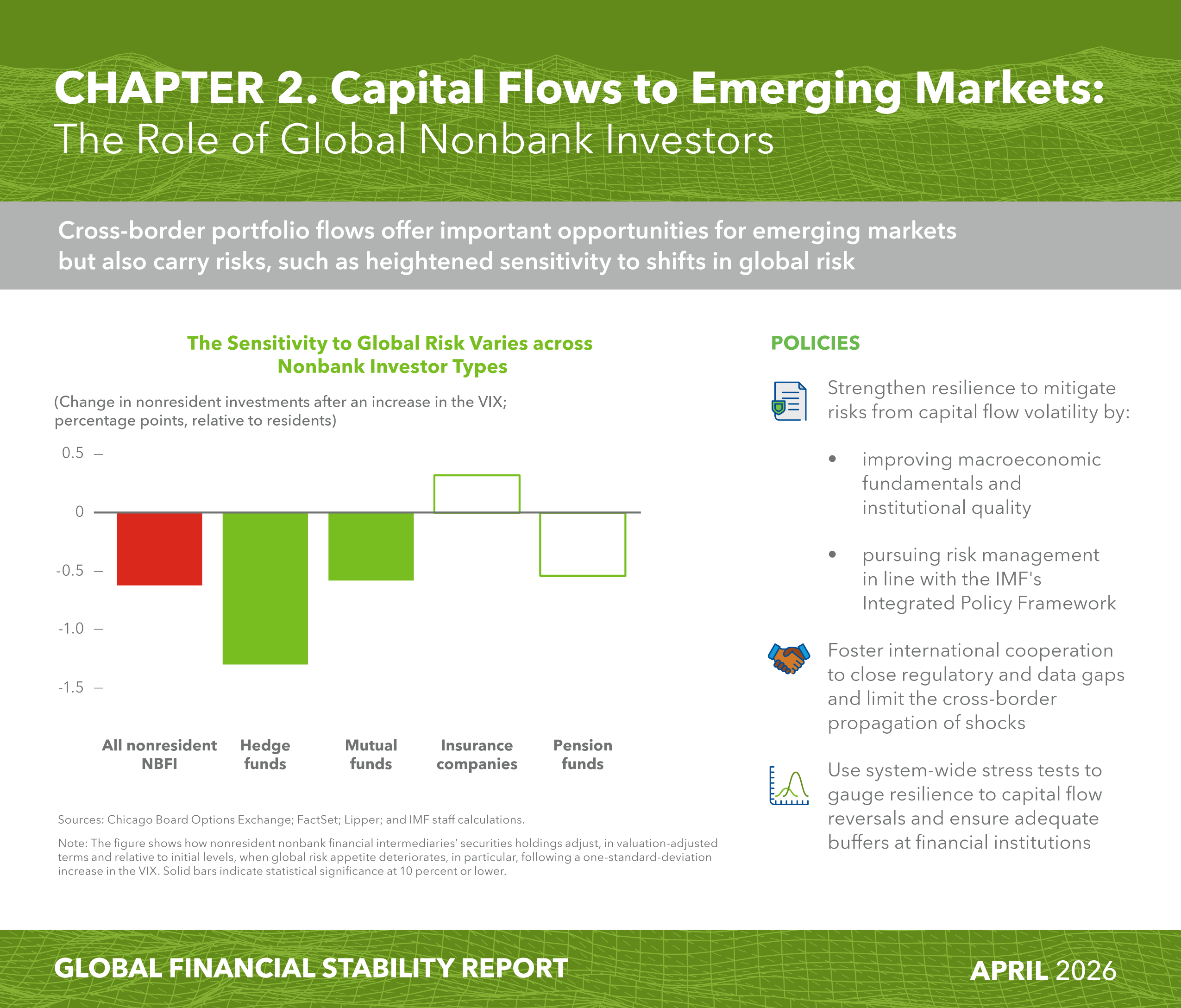
Opportunities and risks abound with international portfolio moves, which are mostly enabled by nonbank financial organisations.
One concern is that these movements make investors more susceptible to shifts in global risk perception.
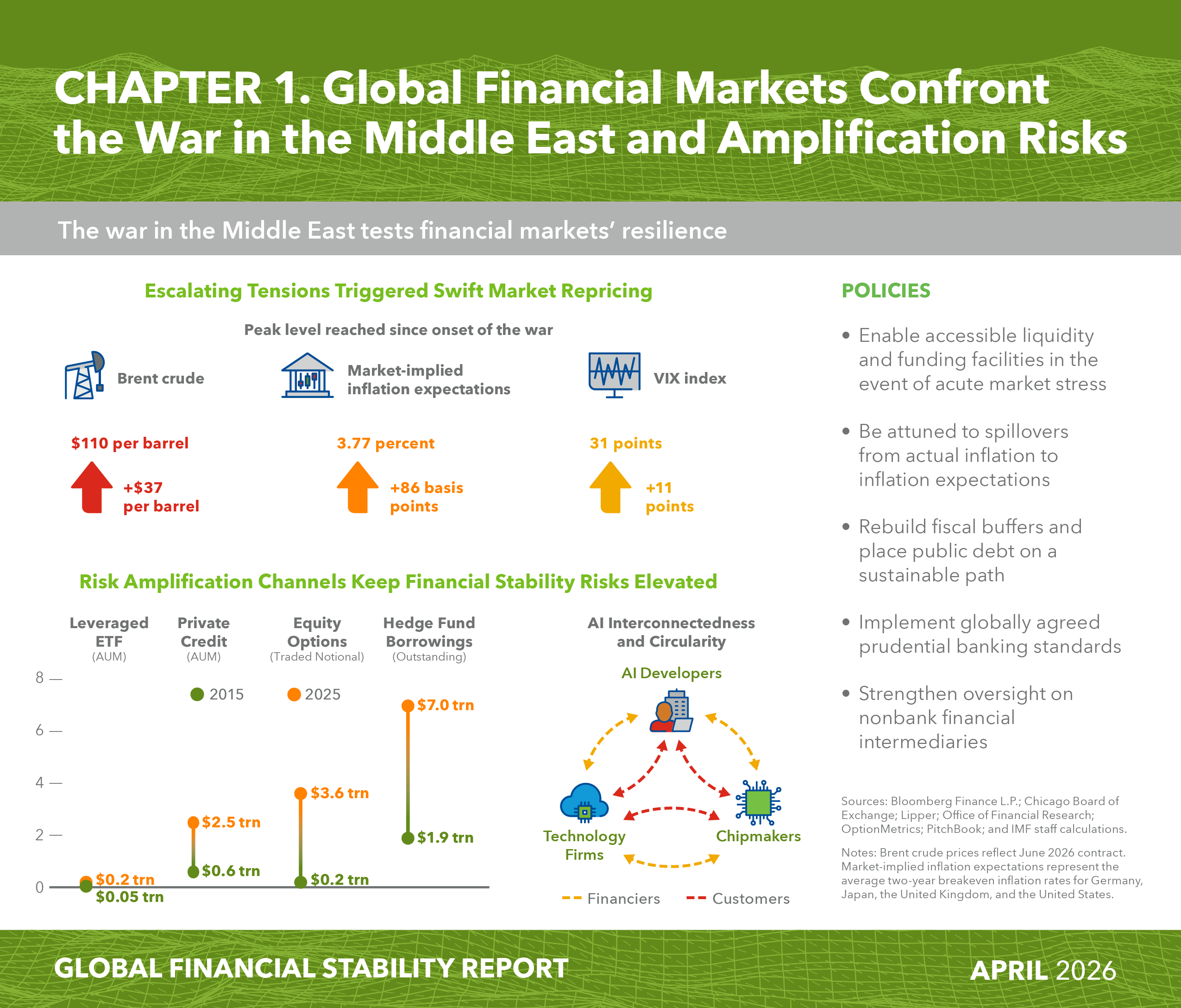
The IMF said the financial world is negotiating the intricacies of the continuing Middle Eastern crisis, in addition to the strains of continuous inflation and growing fears of a more severe tightening of global financial conditions.
A combination of higher energy prices and revised inflation and rate hike predictions has led to falling stock values and rising bond rates since the end of February.
The report assesses that the sensitivity to global risk differs markedly among various investor categories.
Hedge funds and investment funds are more responsive to changes in global risk compared to other nonbank entities, with passive mutual funds and exchange-traded funds exhibiting the highest sensitivity within the fund sector.
The stablecoin market is highly sensitive to market fluctuations in the cryptocurrency industry.
But worries about possible currency replacement are heightened in countries with weak economic foundations and policy frameworks, where demand is often higher.
Key sovereign bond markets are becoming more vulnerable to rollover risks due to increasing public debt and reliance on short-term issuance, which might lead to a reconnection between sovereigns and banks.
Currency pressures in developing economies may become more severe as a result of capital withdrawals and the winding down of carry trades.
The substantial reliance on leverage by nonbank financial intermediaries, such as hedge funds and leveraged exchange-traded funds, might lead to heightened volatility as a result of liquidity constraints and forced deleveraging.
Policy Implications
The report said that Countries ought to enhance their foundational structures, safeguards, and risk management strategies to mitigate erratic capital movements.
Additionally, fostering international collaboration, improving transparency and data exchange, and implementing appropriate oversight of nonbank financial entities—including private credit and stablecoins—are essential to manage cross-border financial vulnerabilities.
To enhance resilience, those in positions of authority must demonstrate courage.
Key objectives encompass finalizing the implementation of Basel III, enhancing the governance of central banks and supervisory authorities, fine-tuning policy frameworks in developing markets, ensuring the sustainability of public debt, advancing data sharing among jurisdictions, and guaranteeing that funding and liquidity mechanisms are fully functional.
The report showed that to mitigate fluctuations in international portfolio movements, nations – particularly those dependent on more risk-averse investor – ought to enhance their macroeconomic foundations and institutional integrity, establish solid fiscal and external safeguards, and adopt proactive risk management strategies in line with the IMF’s Integrated Policy Framework.
Global collaboration is crucial for addressing regulatory discrepancies, mitigating the spread of economic disruptions, and filling data voids. The swift growth of private credit markets and stablecoins in developing regions necessitates ongoing, balanced oversight.
Global Debt & Risks
With a huge increase of $29 trillion in only 2025, the total amount of global debt has reached a historic $348 trillion.
The continuous crises, massive government spending, and growing deficits have driven the overall debt up by almost $120 trillion since 2017. Due to the unstable energy markets caused by the Iran war, the present environment has become even more delicate.
More than just a slowdown in economic activity is indicated when the International Monetary Fund issues a warning about a recession. This also means that there is less money floating across the economy, which is bad news for digital assets.
This is already apparent.
The US Federal Reserve chose not to cut interest rates in April but instead to keep them at unchanged at 3.5%-3.75%. That also indicates the uncertainty facing Fed policymakers from the war and President Trump's trade rhetoric and policies.
Not lowering rates is a typical stance for central banks when inflation is high, especially due to rising oil costs.
There will be less money available for investment possibilities as a consequence of decreased market liquidity caused by higher rates.
When financial circumstances are tight, crypto values tend to fall since the market is so dependent on liquidity. Currently, one Bitcoin trades at just above $73k. There is a buying opportunity for half of the market. The counterargument predicts a short break on the way to $30,000.
Macroeconomic analyst and data scientist Benjamin Cowen presented a pragmatic bearish outlook on April 12. He said the 70% decline from the $126,000 peak in October, indicates a possible bottom around $37,000-$38,000.
Most major cryptocurrencies have fallen by around 50% since October highs, including Bitcoin, Ethereum, XRP, Dogecoin, and Solana. A number of alternative cryptocurrencies have had price drops of 80–90% from their all-time highs. There is already a lot of uncertainty and volatility in the market, and the latest IMF warning about a possible recession just adds to it.