


Table of Contents
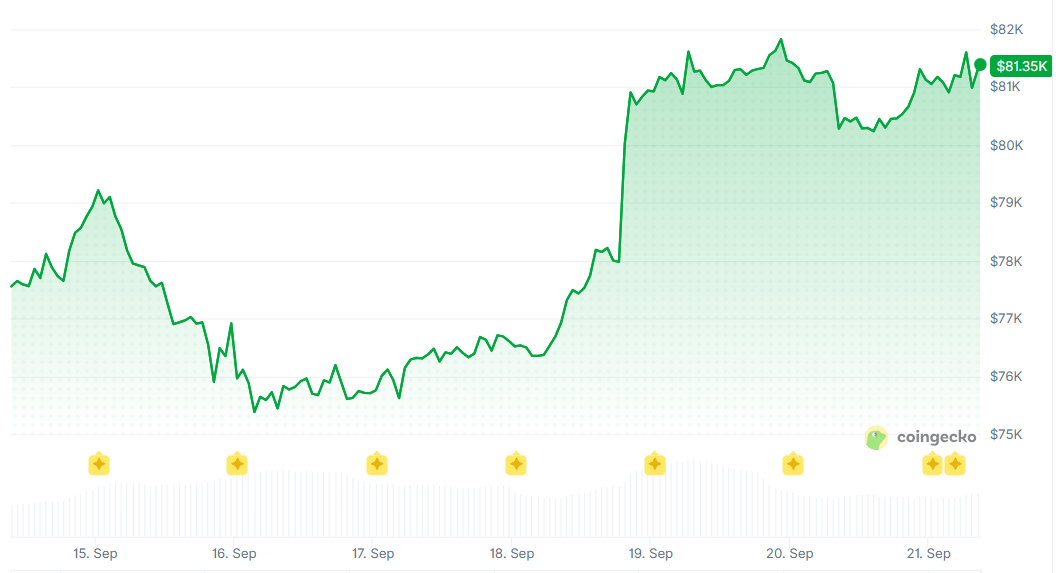
Bitcoin showed resilience late last week, surpassing $81,000 after a brief spike above $82,000 on Friday.
This was despite two seemingly negative developments throughout last week: the Senate's failure to advance the CLARITY Act and the Federal Reserve's first interest rate hike in over three years.
Price action showed no sign of a rally. A course correction was made in reaction to unfavorable events, but things did not get worse.
The Regulatory Paradox: Legislative Failure, Administrative Advance
Cloture failed to reach the required 60 votes to end debate on the Digital Asset Market CLARITY Act on September 15 in the United States Senate, by a vote of 50 to 49.
The goal of the proposed law was to finally settle years of debate over who had jurisdiction over digital assets by dividing their regulatory responsibilities between two agencies.
Since the FIT21 Act stalled in 2024, its failure has been the crypto industry's worst legislative setback.
Although Bitcoin's price fell from almost $80,000 on election day, it was only a momentary setback.
Two days after federal officials shifted their stance, the recovery got underway.
By submitting its crypto market-structure rulemaking to the White House Office of Management and Budget for approval on September 17, the CFTC was able to move forward under its current authority without having to wait for Congress to act.
Qualifying venues may trade tokenized NMS equities on blockchain-based platforms without registering as traditional exchanges thanks to a five-year conditional exemption (the "Innovation Exemption").
The SEC announcement came on the same day.
SEC Chairman Paul Atkins hinted at this plan, saying that he had asked his team to come up with suggestions about crypto custody problems, such as the idea of investment advisors self-customizing crypto assets or using state trust companies as custodians.
The consequences of these activities are evident: agency regulation, not legislative processes, is being used to establish regulatory certainty.
That difference is less important to markets than the outcome, which is the establishment of laws shaped by agencies that have, over the last year, meticulously destroyed the restrictive framework of the previous government.
Despite the legislative process being stalled, Galaxy Research noted that "market regulators are taking action" and that the regulatory environment is still "favorable to the cryptocurrency industry" under the current government.
The Fed Hike That Wasn’t a Surprise
The federal funds target range was adjusted to 3.75%-4.00% on September 16th, following a 25 basis point rate hike by the Federal Reserve. Initiated by Chairman Kevin Warsh, it was the first rise since July 2023.
Unexpectedly, Bitcoin's value jumped from about $75,400 before the announcement to $76,000 after the decision, causing an immediate reaction in the market.
It surpassed $81,000 by September 18th.
The Federal Reserve took a harder line, as shown by its updated dot plot.
Twelve of the 18 officials who offered predictions expected another 25 basis point increase in 2026, and four of those expected two additional raises.
This year, no one expected rates to go down.
The Fed's calculations show that a return to the 2% target will not occur until 2029, which is one year later than earlier forecasts. As a result, core PCE inflation has been modified to 3.4% for 2026.
Warsh stated plainly: “Inflation is too high, and it has been too high for too long.”
With rising real rates, the notional cost of holding a non-yielding asset such as Bitcoin goes up. For the time being, at least, the market has disregarded that signal.
ETF Flows: The Institutional Bid Returns
Spot ETF inflows provided a solid basis for Bitcoin's comeback. With no products showing any outflows, US spot Bitcoin ETFs witnessed remarkable net inflows of $433.03 million on September 18.
Net inflows totaling $159.45 million were recorded the day before.
As a result, the $450.33 million outflow on September 15 and the $295.98 million outflow on September 16 were both reversed.
Regulator reforms and the Federal Reserve's decision were in sync with the shift from net outflows to healthy inflows.
This general pattern lends credence to the case for institutional accumulation.
Net inflows of $3.5 billion were the highest monthly total since September 2025 in August 2026.
The biggest single-day inflow since January came on September 3 with an astounding $454 million registered by BlackRock's IBIT.
Based on these movements, it seems that the institutional investors who make up the ETF's base didn't really see the legislative failure and interest rate hike as a big deal.
The buying didn't happen before the uncertainty was resolved, but after.
Technical Structure: $82,500 as the Line
A series of weekly moving averages - the 20-, 50-, and 200-week EMAs - have been successfully reclaimed by Bitcoin's rebound for nearly a month, a configuration that has normally not indicated new cycle lows.
That lends credence to the claim that the decline to $57,000 in the middle of 2026 was a permanent low point.
The $82,500 mark presents the next obstacle since it is where horizontal resistance meets the midway of an ascending channel.
If it can stay above that level for some time, it would lend credence to the idea that $90,000 is within reach.
If Bitcoin doesn't start moving, it might enter a consolidation phase with important structural support near the $60,000s to $70,000s.
What the Market is Pricing
Last week's events show how the market can tell the difference between ineffective government and merely political maneuvering.
Despite the political damage that the CLARITY Act's failure represented, the SEC and CFTC moved quickly to fill the void within 48 hours.
Although the latest rate hike was forceful, it was the most anticipated tightening in a long time.
Despite the continued regulatory uncertainty, market participants have not substantially altered their risk estimates, according to the Crypto Fear & Greed Index, which registered at 71 - Greed.
Currently, two things are crucial.
An exhaustive investigation is the first step in the OMB's review process for the CFTC.
After this part is complete, the CFTC will vote on the proposal and hear public feedback. Before any legally enforceable rules are put into place, this whole process can last for months.
Additionally, according to the October FOMC meeting, the CME data suggests a little over a 50% chance of an extra 25 basis point hike.
The ability of Bitcoin to stay over $80,000 will determine if the involvement from institutions is a significant change or just a strategic play.
What Other Technical Readings Show
TradingView's technical analysis overview for the week ahead based on key data from moving averages, oscillators, and pivots showed a buy signal.
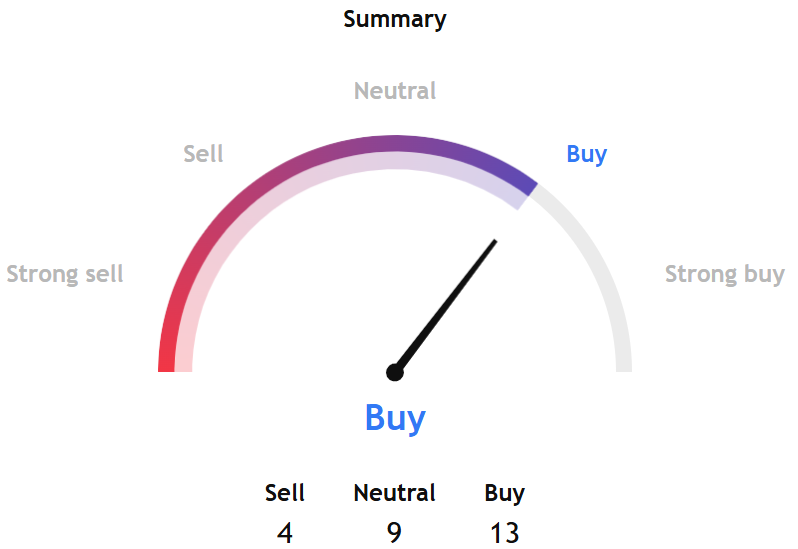
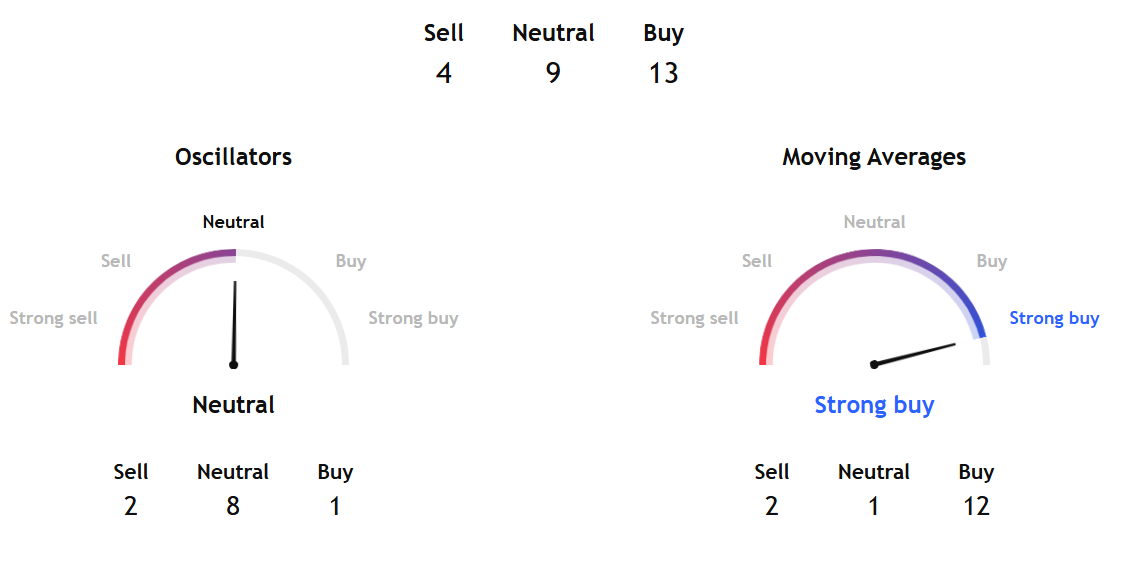
While the moving averages showed a strong buy stance, the short-term oscillators pointed to a neutral signal.
Separately, InvestTech's Algorithmic Overall Analysis gave a hold score, while its score for one to six weeks recommendation was a Weak Negative.
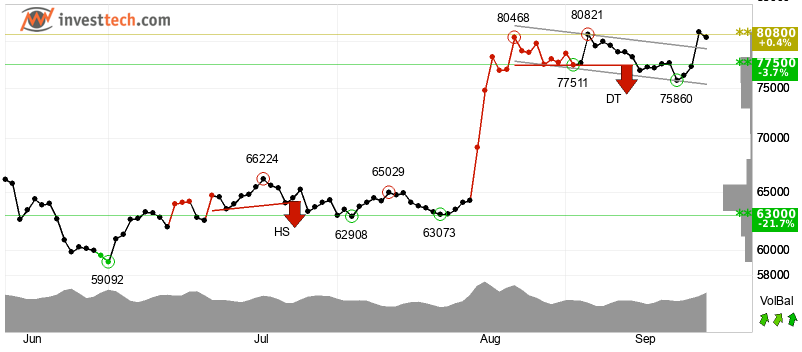
InvestTech noted, "Bitcoin has broken the ceiling of the falling trend in the short term, which indicates a slower initial falling rate. The currency is testing resistance at $80,800. This could give a negative reaction, but an upward breakthrough of 80,800 means a positive signal."
The research added, "The currency is assessed as technically slightly negative for the short term."