


Table of Contents
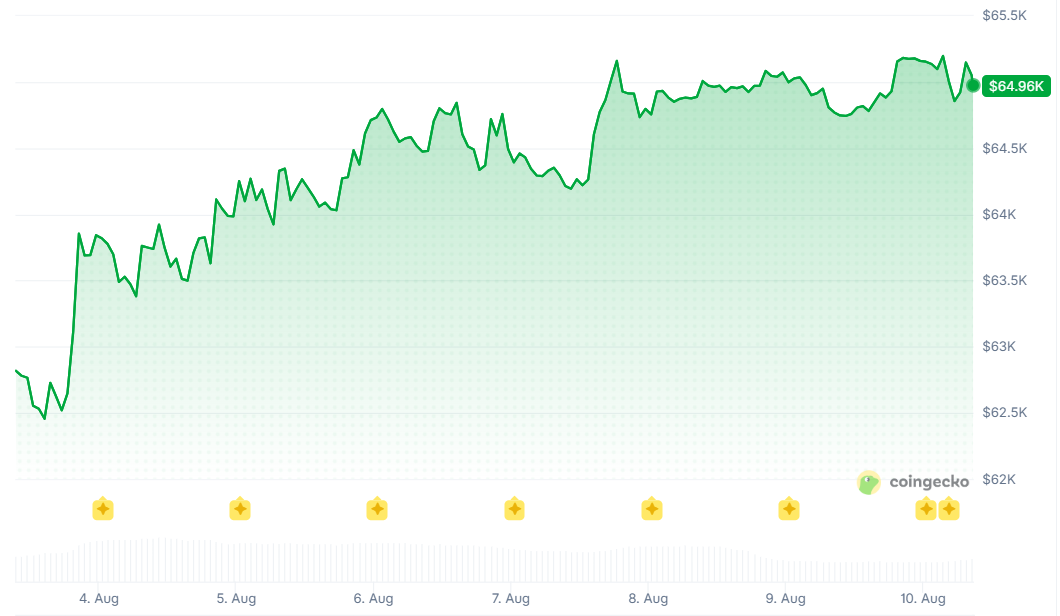
The total crypto market has barely moved this week — up 0.31% to $2.21 trillion, with Bitcoin pinned between $64,730 and $65,193, according to CoinGecko data. Underneath that flatness, three separate signals are pulling in the same direction: capital is starting to rotate out of Bitcoin's shadow, options markets are pricing in far less risk than bond markets are, and speculative leverage in small-cap tokens is at levels that typically precede a broader repricing.
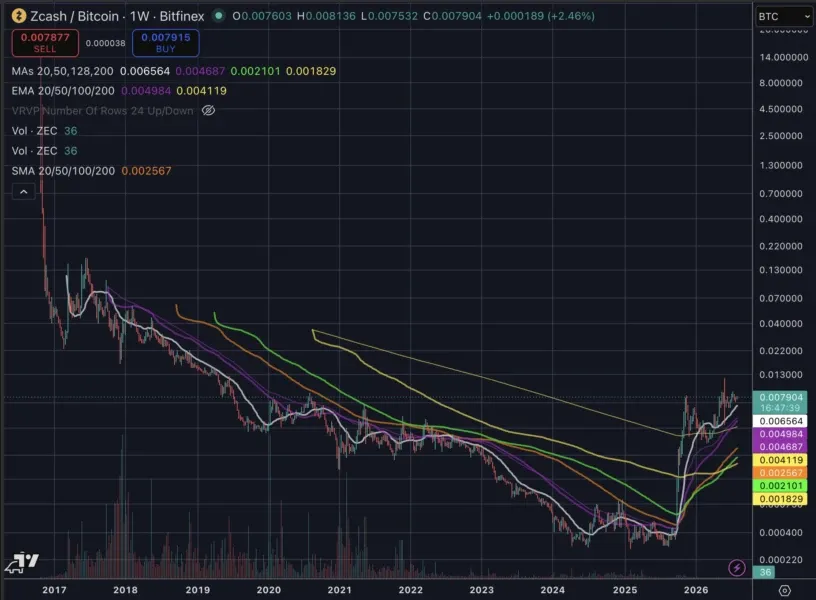
The clearest of the three is technical. The ZEC/BTC pair broke a nine-year downtrend this week, consolidating at 0.007904 BTC — comfortably above its 200-period simple moving average of 0.002567 BTC. Placeholder co-founder Chris Burniske called it evidence that the old pattern, in which short-term Zcash rallies preceded broader altcoin capitulation, no longer applies. Digital Currency Group founder Barry Silbert has floated a further reading: that the pace of inflows into Zcash could push its market cap toward 10% of Bitcoin's, a roughly $130 billion benchmark, if the current move sustains. Burniske has cautioned that Bitcoin still sets the market's overall liquidity conditions, meaning any Zcash-led rotation remains vulnerable to a Bitcoin-driven correction.
That caution matters more given what's happening in Bitcoin's own options market. Bitwise's head of alpha strategies, Jeff Park, wrote on X on Aug. 8 that Bitcoin's implied volatility has hit a year-to-date low at the same time Treasury yields have climbed to a year-to-date high — a divergence he said "can only end one way." The logic is straightforward: bond markets are pricing in more macro stress, but Bitcoin options traders are pricing in less price movement than at any other point in 2026. Compressed volatility of this kind has historically preceded sharp breakouts rather than sustained calm, though the direction of that break is not something implied volatility alone can predict.
Bitcoin implied volatility hits YTD low
— Jeff Park (@dgt10011) August 8, 2026
US bond yields hit YTD high
This can only end one way pic.twitter.com/fH8WUBFO9k
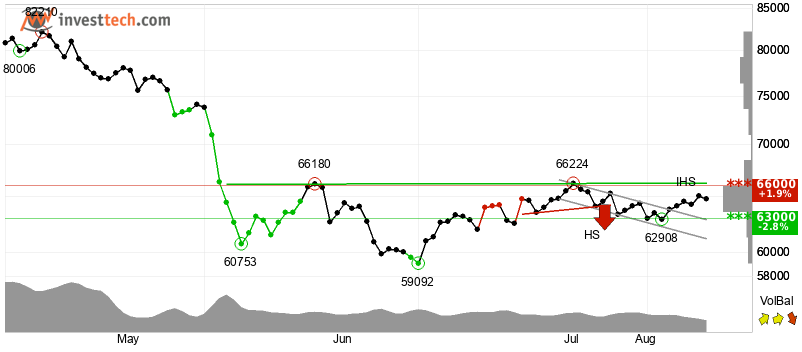
The range itself remains tightly bounded. Analyst Lennaert Snyder noted on Aug. 8 that Bitcoin had failed twice to clear $65,400, with support holding near $62,300 — a setup he read as reason to avoid new short positions until a confirmed breakout in either direction. Separately, a cluster of analysts including Michaël van de Poppe and Rekt Capital have pointed to the 50-month exponential moving average, currently near $65,827, as the level bulls need to reclaim to invalidate a longer bear-market structure. Bitcoin has been rejected from the area above $65,000 several times since late June, and CryptoQuant data shows large wallets (10,000+ BTC) accumulating at a multi-month high even as retail-sized wallets have been net sellers over the same stretch — a split that suggests larger holders see more upside than the price action currently reflects.
Where leverage is showing up most visibly is in the BSC ecosystem's smaller tokens. Tutorial (TUT) surged more than 1,100% over two days after Aster listed 5x leverage perpetual contracts on Aug. 7, hitting an all-time high of $0.2903 on Aug. 9 before dropping roughly 42%. In the process, TUT logged more in single-day liquidations — over $42 million, according to CoinGlass data cited by DailyCoin — than Bitcoin or Ethereum individually, despite a market capitalization of just $140 million. MUBARAK saw a comparable pattern after Aster launched its own 5x perpetual contract, and Bubblemaps (BMT) posted a 149% single-day gain on $366 million in volume against a $26.6 million market cap — a turnover ratio north of 13x that reporting attributed to speculative demand rather than any identifiable catalyst. None of these moves reflect underlying adoption; they reflect thin float, high leverage, and the mechanics of forced short covering followed by forced long liquidation once momentum reverses.
Taken individually, none of these three threads is decisive. Together, they describe a market where the pricing of risk has become inconsistent. Bond markets are signaling more macro stress. Bitcoin's options market is signaling less. A structural rotation into an asset that spent nine years losing ground to Bitcoin is being treated by at least one prominent allocator as a benchmark-setting event. And leveraged trading in illiquid BSC tokens is generating liquidation volumes that rival Bitcoin's on a $140 million market cap. Low implied volatility does not resolve on its own — it resolves through a move, and the size of that move tends to scale with how long the compression has persisted. Whether the resolution comes from the Federal Reserve's next signal on rates, a Zcash-led rotation that forces Bitcoin to defend its dominance, or a memecoin unwind spilling into broader risk appetite, the setup argues against reading this week's flat headline number as calm.