


Table of Contents
Cleveland Fed President Beth Hammack has not exactly sent a dovish signal by expressing a preference for "smaller, more frequent" rate adjustments.
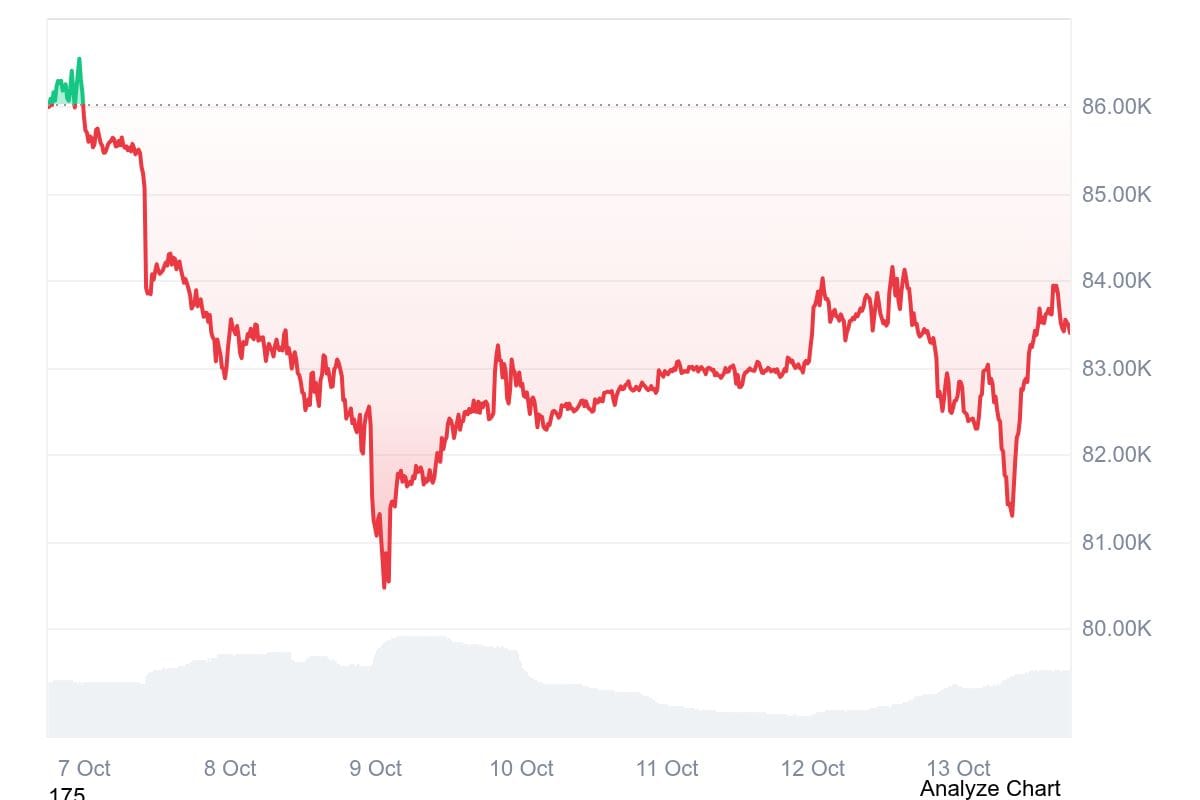
With a price range of $82,000 to $87,000, the crypto market is pricing in the ambiguity that adopting this legislative framework would create, which would restrict Bitcoin's fiat-liquidity fuel line.
The Surface Read
At Monday's National Association for Business Economics meeting, Hammack expressed the view that "where practical, I generally think it's preferable to make modest adjustments, and to do so reasonably quickly, rather than to wait and risk needing a greater course correction."
When the FOMC meets on October 27 and 28, she will not be entirely in favor of a rise.
Already, the markets had changed.
The probability of a rate hike in October fell sharply, according to CME FedWatch data, from over 66% at the start of the week to 18-22% by Friday.
On October 12, spot prices for Bitcoin were about $84,232, showing a 1.28% increase over the previous 24 hours, indicating a measured rebound.
Nevertheless, it is still limited by the strong $85,230 resistance level, which has blocked all attempts at a rally since the end of September.
A hawkish person softens their position, interest in risk assets rises, and the probability of rate hikes falls.
This is the most obvious conclusion. But not everyone agrees.
The Plumbing Behind the Rhetoric
Regarding rate direction, Hammack's use of the term "smaller adjustments" is irrelevant.
It has to do with the complexities of changing policy frameworks.
Over the past year, she has tirelessly advocated for higher tariffs and the continuation of a stringent policy.
Regarding the Fed's additional tightening measures, the "smaller, quicker" approach is a strategic decision; it does not indicate a stop in actions.
After nine months of stability, the Federal Reserve finally made an adjustment in September, increasing the target range for interest rates to 3.75–4.00%.
At least one more 25 basis point hike is expected this year, as the median year-end 2026 rate was lifted to 4.1% in the September dot plot.
While stressing the need for flexibility that "doesn't have to occur at consecutive meetings," Governor Christopher Waller hinted on Thursday that further increases "may still be necessary" if the evidence justifies such action.
The market reacted to Waller's flexibility, whereas Hammack was hesitant to commit early.
Why Bitcoin’s Bid Is Hollow
A more indicative sign is that Bitcoin has not been able to convert macro respite into price discovery.
In early October, the asset's value soared to $87,000, following a dismal September payroll report that showed only 29,000 jobs were gained.
Bitcoin fell to $82,000 in a matter of days despite data that normally triggers a 5-10% rally in a market where liquidity is the driving force.
There is a structural root cause.
After three weeks of inflows, spot Bitcoin ETFs saw net withdrawals of $681 million during the week of October 5–9.
The biggest daily withdrawal since June 25 was $484.9 million, which occurred on October 8, the most important day.
A loss of $207.7 million was recorded by BlackRock's IBIT. The exchange-traded funds for Ethereum and Solana had a large withdrawal of $567 million.
When it comes to measuring institutional marginal demand, ETF flows are the gold standard.
There was more tactical than strategic support for Bitcoin in September, as inflows dropped from $2.39 billion two weeks ago to $241 million, and then there were outright outflows.
Miner Overhang
The ETF numbers mask a deeper, more subtle supply strain. To reinvest in artificial intelligence infrastructure, JP Morgan's researchers estimate that Bitcoin miners have sold over $1.8 billion worth of cryptocurrency this year.
This is the result of an increase in supply flooding a market where buyers are becoming increasingly picky. At present, 848,000 BTC, or around 4% of the whole Bitcoin supply, are held by Strategy, the leveraged treasury firm that has served as the market's safety net.
Nevertheless, the corporation is unable to issue new shares in order to purchase more coins because its preferred share instrument, STRC, has fallen below its $100 par value.
The automated system that capitalized on every market downturn has just encountered a technical issue.
What 'Smaller and Quicker' Actually Means
If the Federal Reserve were to follow Hammack's model, it would shift from making large, one-time changes of 25 basis points during planned meetings to making smaller, more frequent adjustments, maybe even between meetings.
Bitcoin would really benefit from a central bank that could respond instantly to inflation measurements instead of waiting six weeks.
Considering the asset's volatility, that might go either way.
The effects of accelerated tightening in response to higher inflation would be more noticeable and noticeable more quickly. Also, in the event of an economic slump, relief measures would be put in place more rapidly.
However, a shift in cadence would not cause the net liquidity impulse, which is a characteristic that impacts Bitcoin trading, to reverse.
Market pricing at the moment shows that this predicament is well understood. In October, the likelihood of a rate increase according to Polymarket was around 18%. A lot is happening in December.
The interest rate policy of the Federal Reserve has not changed.
Rate hikes before year's end are still being considered, and how quickly they could be implemented if needed is a topic of continuing discussion.
The Technical Trap
The structure of Bitcoin's chart illustrates the market's wider uncertainty.
The asset is currently trading above its simple moving averages for the past seven, twenty, fifty, and two hundred days, which is a sign of strong performance.
At $84,165, it is still near the 20-day simple moving average (SMA), but it has persistently struggled at $85,230. At the moment, the upper Bollinger Band is set at $86,298 and the lower band at $82,033.
The location of the bands is neutral.
Although there is no volume confirmation, the MACD shows convergence, which could be a turning point.
Compared to recent patterns, Binance's spot trading volume on October 12 was relatively low at $714.8 million.
The following is a breakdown of the targets: CoinDCX has set a minimum of $83,503, an optimistic scenario of $92,000, and a base case of $87,000.
Key structural supports indicating areas of on-chain accumulation, according to more pessimistic models, are $77,000 and $72,000.
The Real Signal
Hammack’s comments are not the focal point. The Cleveland Fed President suggests a radical change to the way policies are put into action, calling for a system that is smaller, faster, and more flexible.
Bitcoin, meanwhile, has not been able to form a convincing breakout, even if there has been talk that interest rate hikes may become slower and less aggressive.
This proves that the rate of tightening is unrelated to the market problem.
This is the way forward. An increase in the net liquidity of Bitcoin is necessary.
It necessitates that the central bank stop taking money out of the market and start putting money into the economy.
The September dot plot, Waller, and Hammack all point to the same thing: the moment is not yet right.
The ongoing overhead supply that has defined October will keep Bitcoin's upward movements limited until there is a noticeable change in monetary policy, not just a stop or slower climb, but a full turnaround.
The $87,000 mark remains a stumbling block for the bulls.
That dynamic remains unchanged despite Hammack's preference for quick, minor moves.