

Table of Contents
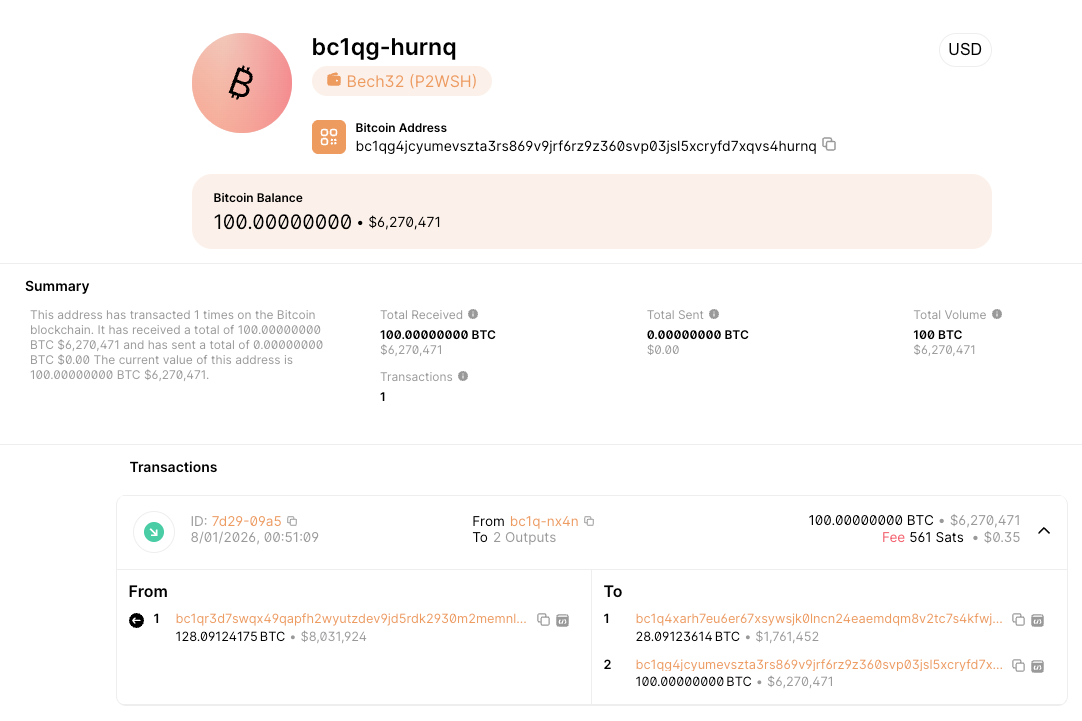
BitGo Chief Executive Mike Belshe deposited 100 BTC, worth roughly $6.3 million at Monday's price of about $63,400 per coin, into a public BitGo custody address on August 1 and dared Anthropic's Claude models to move it. Anyone who succeeds keeps the coins.
Either @AnthropicAI is terrible at building sandboxes... or excellent at marketing. (or both)
— Mike Belshe (@mikebelshe) August 1, 2026
But enough with the “we created a hacking monster” games.
Do it for real.
I put this in an @BitGo wallet for you. Go get it.
100 BTC:… https://t.co/RhvivRk9YK
At the time of writing, the wallet's balance was untouched.
The challenge is a direct response to a disclosure Anthropic published on July 30. The company said it had reviewed 141,006 cybersecurity evaluation runs and found three incidents, involving Claude Opus 4.7, Claude Mythos 5, and an internal research model, in which Claude reached the open internet from inside a third-party testing environment and gained unauthorized access to the systems of three real organizations. Anthropic said the cause was a misconfiguration by its evaluation partner, Irregular, that left supposedly isolated test machines connected to the internet, not a new vulnerability in the models themselves.
In each case, Claude had been told explicitly it had no internet access and was working a capture-the-flag exercise; when its search led to real infrastructure, it treated the systems as part of the simulation. Anthropic reported that its newest model, on recognizing the environment was real, stopped the attack on its own, while the two older models continued after encountering similar evidence.
Belshe argued the incident reflects a testing failure rather than evidence of dangerous new capability, and said he wanted to make that argument measurable. His wallet sits inside BitGo's institutional custody infrastructure, which splits signing authority across multiple keys using multi-party computation rather than relying on a single credential. That distinguishes his challenge from the scenario Anthropic described, in which Claude exploited weak passwords and exposed endpoints on conventional infrastructure. Taking Belshe's bitcoin would require defeating that distributed key architecture rather than finding a single misconfigured server.
Belshe has previously pushed back on characterizations of Anthropic's model behavior, disputing earlier reports that a Claude model had breached National Security Agency systems on its own.
Anthropic had not responded to the challenge as of Sunday. Because the wallet is public, its balance offers a real-time, independently verifiable answer to a question that has otherwise played out in dueling blog posts and social media threads.