

Table of Contents
Securitize Corp. began trading on the New York Stock Exchange on Thursday, July 2, 2026 under the ticker SECZ, making it the first newly public company to bring its own stock onchain at the start of its life as a listed entity.
The listing resulted from a merger with Cantor Equity Partners II, a SPAC that raised approximately $400 million and valued Securitize at $1.25 billion pre-deal. About 71% of the SPAC's cash pool remained in the merger rather than being withdrawn by investors – a signal of relative sponsor confidence in the deal structure at a time when many crypto-adjacent listings have stalled.
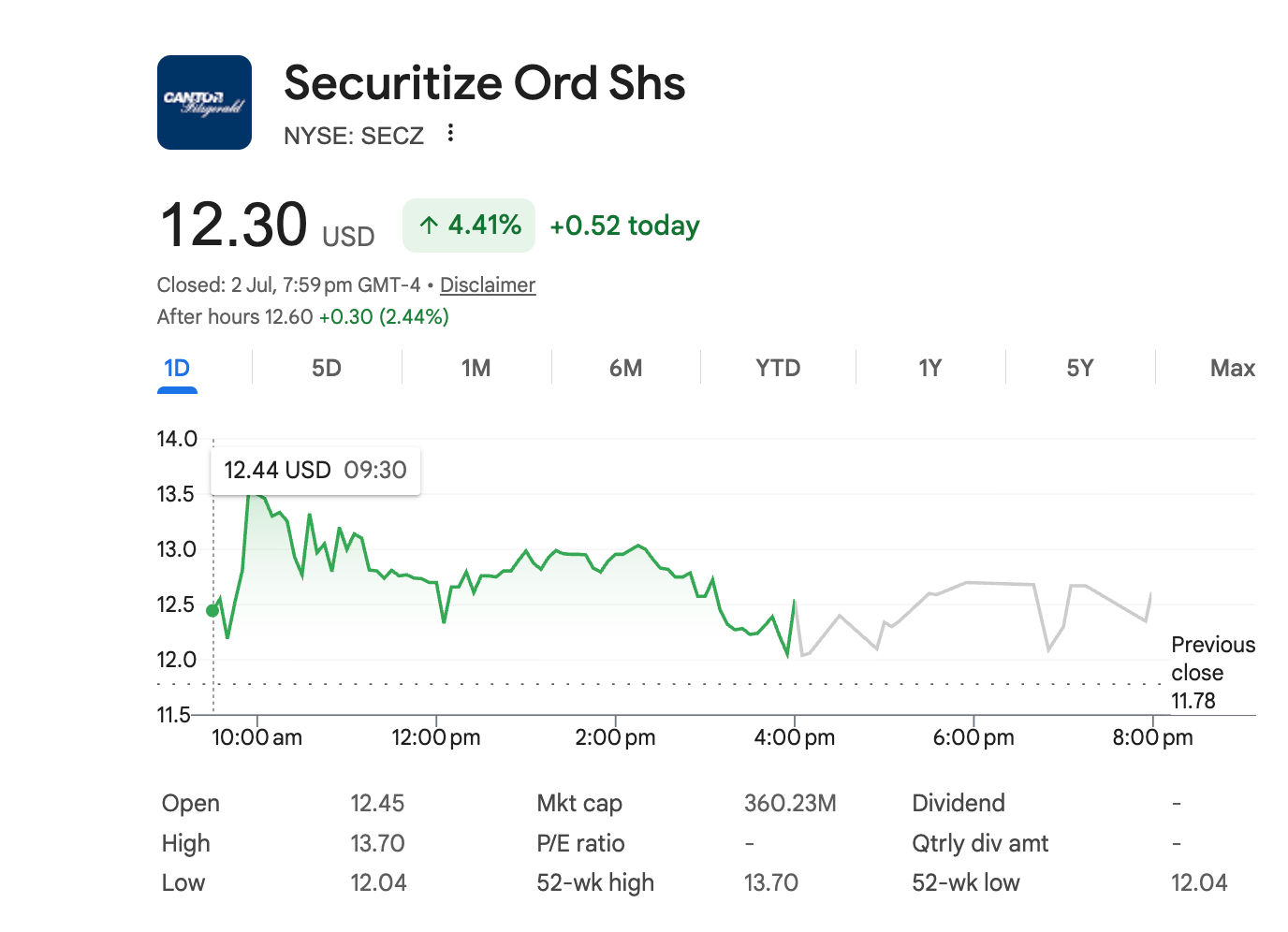
Shares rose roughly 3% on debut after pre-market trading saw SECZ fall briefly below its IPO price.
The onchain debut
On the same day as its NYSE listing, Securitize made tokenized versions of its common stock available to eligible US investors through its regulated platform, initially on Avalanche and Solana. The company claims this makes SECZ the world's largest tokenized stock at launch, based on expected shareholder participation, it said in a statement.
Tokenized SECZ is designed to represent the same common stock trading on the NYSE, not a separate share class. Tokenization changes the form of ownership; it does not alter the underlying share rights or override legal and transfer restrictions. Access on the platform requires standard KYC/AML checks and jurisdictional eligibility verification.
Carlos Domingo, co-founder and CEO of Securitize, framed the move as a deliberate statement of confidence in the regulatory pathway his firm has built. "SECZ is not a synthetic token or offshore wrapper," he said in a press release. "It is issuer-sponsored tokenization of the same common stock trading on the NYSE, made available through regulated infrastructure. This is how tokenization should scale: with real ownership, regulatory clarity and the issuer at the center."
Brett Redfearn, Securitize's president, was more direct at the NYSE bell ceremony: "We're at a tipping point in tokenization."
Context: a patchy year for crypto listings
Securitize's debut stands out against a broader slowdown in crypto-adjacent IPOs. Circle completed its IPO in June 2025, followed by Gemini in September 2025 and BitGo in January 2026. But the anticipated wave has not materialized. Kraken put its multibillion-dollar IPO on hold in March 2026, citing hostile market conditions, according to CoinDesk. Tokenization-focused listings have faced particular skepticism given the nascent state of secondary market infrastructure for digital securities.
That context makes Securitize's simultaneous onchain launch commercially significant. It is not just a public company listing—it is a proof of concept for issuer-sponsored tokenization at scale, with the same asset existing on a traditional exchange and on-chain rails from day one.
The 24/7 question
The NYSE partnership announced in March 2026 is worth revisiting here. Under that agreement, Securitize became the exchange's first digital transfer agent for tokenized securities, and both parties outlined plans for a 24/7 trading platform for tokenized equities. That would represent a structural departure from current US equity market hours, which run roughly 9:30 a.m. to 4 p.m. Eastern on weekdays. A closing bell ceremony is scheduled for July 6.
Securitize currently manages over $4 billion in assets under management across tokenized funds, including the BlackRock BUIDL tokenized money market fund. The firm counts Apollo, BNY, Hamilton Lane, KKR, and VanEck among its partners. In 2024, BlackRock led a $47 million investment into the company.
The dual-nature of SECZ – living on both blockchain infrastructure and a traditional exchange – creates compliance and operational questions that the market has not yet stress-tested at scale. How tokenized SECZ behaves relative to its NYSE counterpart around corporate actions such as dividends or stock splits remains to be seen.