

Table of Contents
A coordinated selloff across equities, metals, and crypto wiped approximately $1.88 trillion in market value on June 9, after US President Donald Trump announced a military response against Iran following the downing of an American Apache helicopter near the Strait of Hormuz. The move triggered a broad risk-off shift that hit Bitcoin, U.S. equities, and precious metals simultaneously. Bitcoin fell to an intraday low of $60,892, extending its decline as Trump's Truth Social post confirmed U.S. Central Command had launched retaliatory strikes against Iranian military targets. The geopolitical escalation raised fears that the ceasefire established earlier this year could unravel, increasing the risk of a broader regional conflict.
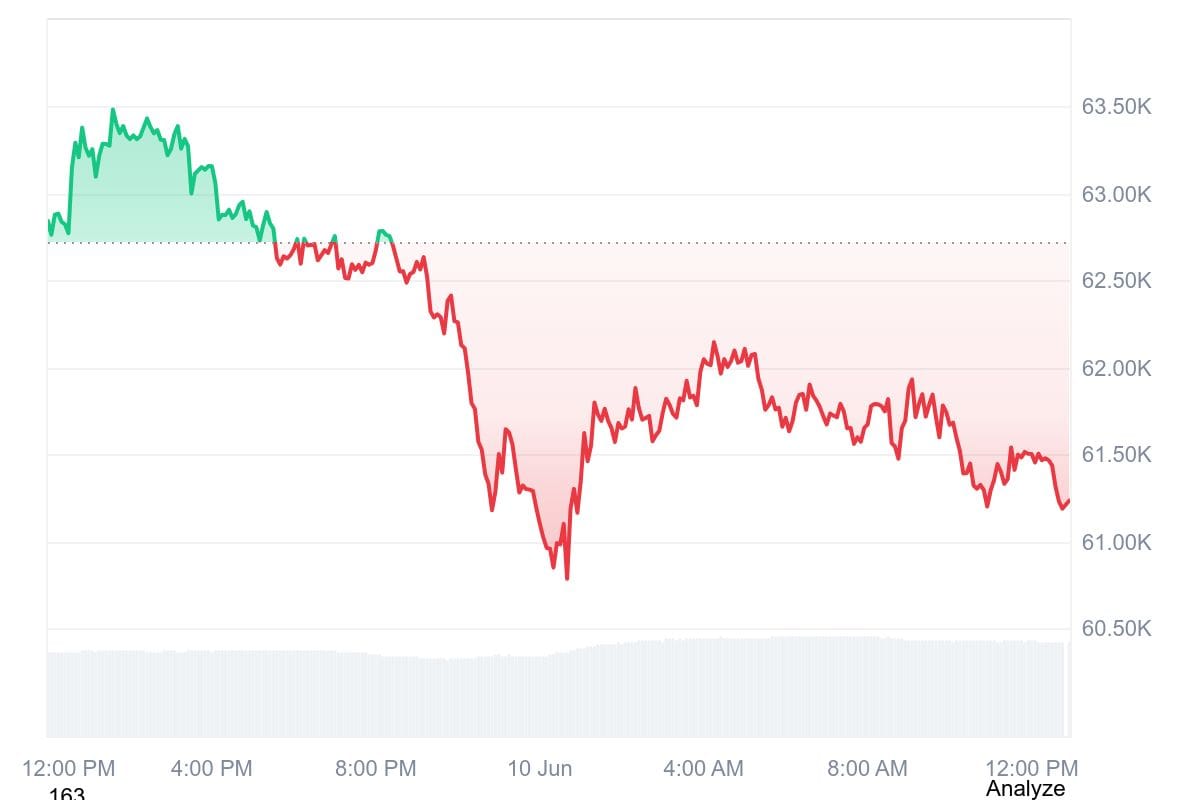
The damage was widespread. The S&P 500 fell 1.62%, erasing approximately $1.1 trillion in market value, while the Nasdaq dropped 2.50%, losing $880 billion. Gold declined 1.95% and silver fell 5.56%, reducing precious metals market values by roughly $570 billion and $220 billion respectively. The Russell 2000 shed 2.06%. Crypto derivatives markets absorbed significant forced selling. Total liquidations reached $664.86 million over 24 hours, with Bitcoin traders accounting for $124.22 million of those losses, per CoinGlass data. Bitcoin open interest slipped 0.25% to $45.13 billion as traders reduced leverage and risk exposure. The episode exposed the degree to which crypto markets have become sensitive to macro risk factors. Bitcoin's decline preceded and paralleled the equity selloff, suggesting that crypto no longer operates as a distinct risk asset insulated from geopolitical developments. That correlation has strengthened as institutional participants — many of whom hold both crypto and equities in the same portfolio construction — have increased their exposure to digital assets. Beyond the geopolitical trigger, Bitcoin continues to face structural pressure from weakening institutional demand. U.S. spot Bitcoin ETFs have suffered approximately $4.4 billion in outflows between May 15 and June 8, according to SoSoValue data. The sustained capital flight points to a broader decline in institutional risk appetite, a dynamic that the geopolitical selloff may have temporarily amplified rather than caused. Onchain metrics reinforce the somber picture. According to Glassnode, more than 8 million BTC are now underwater — a significant reset from the cycle peak when nearly half of Bitcoin's circulating supply was in profit. The Crypto Fear & Greed Index remains firmly in "Extreme Fear" territory at 10, underscoring persistent concerns over ETF outflows, macro uncertainty, and now escalating geopolitical risk. Whether the $60,000 level holds will determine near-term direction. Wintermute has identified a significant liquidity gap between $50,000 and $59,000 that could expose Bitcoin to sharp moves lower if support fails. For now, traders are watching for whether geopolitical developments stabilise or intensify — the most direct variable for risk appetite across both crypto and equity markets.