
Table of Contents
One historic measure is altering the regulations after a decade of regulatory uncertainty; this might have historic ramifications for the adoption of Bitcoin.
It wasn't volatility, energy worries, or public mistrust that impeded Bitcoin's widespread adoption during the most of its fifteen-year existence.
It was vagueness.
The Clarity Act, also referred to as the Digital Asset Market Clarity Act of 2025, is experiencing remarkable momentum in Washington, DC, especially when compared to two years ago.
This shift is largely due to the ongoing struggle between two influential federal agencies, the Securities and Exchange Commission and the Commodity Futures Trading Commission, over jurisdiction in the digital asset space.
As a result, every entrepreneur, institution, and individual investor caught in this dispute has faced significant challenges, including legal expenses, postponed products, and lost market opportunities.
It seems that this tumultuous period may be coming to an end. Just two years prior, the Clarity Act would have seemed far-fetched as it navigated through the corridors of power in Washington.
After being passed by the House on July 17, 2025, with a bipartisan vote of 294 to 134, the bill is now scheduled to be marked up by the Senate Banking Committee later today.
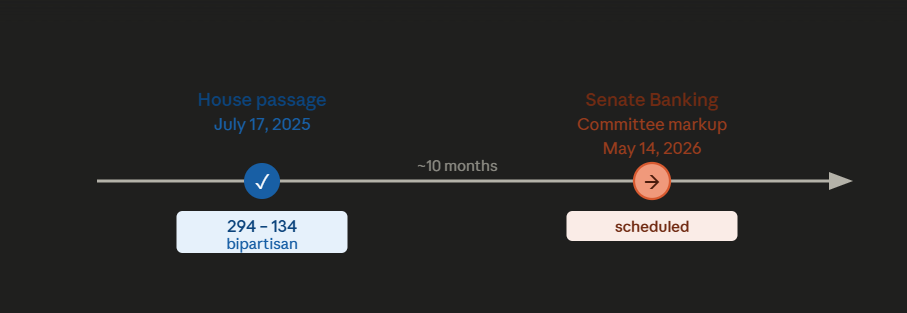
The chart shows the two key milestones: the bill's bipartisan House passage in July 2025, and the upcoming Senate Banking Committee markup scheduled for May 14 — roughly 10 months later.
If this bill passes committee, then the full Senate, and finally reaches President Trump's desk before the July recess, it will be the most significant financial law since Dodd-Frank, with seismic implications for Bitcoin in particular.
Michael Saylor Bets on Clarity Act
According to Michael Saylor, new crypto laws in the United States would make it easier for digital asset financing and Bitcoin to break into the capital markets.
The CEO of Strategy presented the Clarity Act amendment as more than just another regulatory hurdle, claiming that it has the potential to open up new markets for digital equities, digital credit, and digital finance.
His remarks coincide with the impending examination of the act by lawmakers.
This measure aims to clarify the role of the Securities and Exchange Commission (SEC) and the Commodity Futures Trading Commission (CFTC) in overseeing the cryptocurrency markets.
There is immediate market significance to the Strategy argument.
According to Saylor, the bill has the potential to legitimize Bitcoin, encourage more widespread use of MSTR, and establish a more solid foundation for STRC, the preferred shares known as "Stretch" that the firm offers.
Given that the company's public-market brand has been created around Bitcoin-backed corporate financing, the policy issue takes on added significance.
Strategy has strengthened its Bitcoin position through the use of common stock, preferred shares, and other capital-market mechanisms, making regulatory certainty an integral aspect of the overall investment case.
Also included in the discussion are stablecoins.
The current wording of the bill allows for payment-related incentives but limits the yield on idle holdings, which is a big deal because different crypto companies, banks, and lawmakers have different ideas about how stablecoins should fit into the US financial system.
Just because the bill has been marked up doesn't mean it's close to becoming law; it still has to go through the Senate, take into account any amendments, and align with the House before a final framework can be shaped.
A reward-related compromise is included in the bill's present text, which limits yield on idle holdings while permitting payment-related incentives.
As various crypto companies, banks, and lawmakers advocate for various visions of stablecoin activity's place in the American financial system, this differentiation has emerged as a central topic of contention.
However, the market is paying careful attention because of Saylor's reaction.
The discussion surrounding crypto regulation is shifting from focusing just on exchange regulations or enforcement to asking how Bitcoin, stablecoins, and tokenized capital structures may integrate into traditional finance.
These days, guidelines for exchanges and enforcement are just two sides of the crypto regulatory spectrum.
Where tokenized capital structures, stablecoins, and Bitcoin fit into the grand scheme of things is starting to becoming more of an open topic.
The Decade-Long Problem Clarity Solves
To grasp the significance of the Clarity Act, it is necessary to grasp the confusion that existed prior to its passage.
When crypto projects were launched in the US, there was a basic legal question that needed to be answered: would the SEC have jurisdiction over these tokens if they were securities, or would the CFTC have jurisdiction if they were commodities?
Historically, the SEC asserted authority over most tokens by using the Howey Test, the same standard used to categorize traditional investment contracts, while the CFTC deemed Bitcoin, being a decentralized asset without an issuing company, clearly qualified as a commodity.
In practice, this jurisdictional grey area led to a compliance nightmare. Companies would guess which agency applied, and they would often get the answer through enforcement letters instead of clear regulations.
According to Treasury Secretary Scott Bessent's Wall Street Journal op-ed that framed the Clarity Act as a national security issue, the result was that local innovators went to Singapore, the Cayman Islands, and Abu Dhabi, while offshore exchanges prospered.
Blockchain engineers and crypto firms are still making the move to Abu Dhabi and Singapore due to the lack of legislative clarity in the US.
Where the new financial system is constructed is at the heart of the Clarity Act, which goes beyond being a mere tech policy.
What the Bill Actually Does
Bitcoin, with its lack of a founding company, pre-mine controlled by insiders, and centralized development team able to influence prices, fits comfortably in the commodity category.
The act essentially draws the line that the market has been demanding for a decade: digital assets that function like investment contracts, where buyers expect profits based on someone else's efforts, should be supervised by the SEC.
On the other hand, assets that live on decentralized networks and function more like raw commodities should be exclusively regulated by the CFTC in spot markets.
This reclassification transforms Bitcoin from a regulatory gray area into a legally defined asset class with a distinct government home, making it more than just a little administrative detail.
What This Means for Adoption
The response of Bitcoin's price to the news surrounding the Clarity Act was quite revealing.
In early May 2026, when a Senate compromise on stablecoin yield provisions indicated a resurgence of legislative activity, Bitcoin surged beyond the $80,000 threshold, despite Michael Saylor's Strategy — one of the market's most significant buyers — reducing its acquisition rate.
This type of price movement in the absence of conventional purchasing pressure indicates that the market is pricing in something structural: the potential for a long-term institutional inflow cycle that is far larger than what transpired after the January 2024 approvals of Bitcoin ETFs.
The reasoning is clear.
Pension funds, insurance companies, and sovereign wealth managers are not avoiding Bitcoin due to a dislike for it — rather, they are restricted from holding significant amounts because their compliance teams cannot approve an asset that lacks a clear regulatory framework.
Once federal law classifies Bitcoin as a commodity under CFTC jurisdiction, that single statement opens the door to capital sources that have been observing the market from a distance for years.
Prediction market site Polymarket currently estimates the likelihood of the Clarity Act being passed in 2026 at 67%.
Additionally, the White House, along with regulatory agencies and the largest domestic exchange in the country, has indicated a public alignment on this matter.
If the bill fails to pass through the Senate Banking Committee before Memorial Day, the next opportunity for legislative action may be delayed until 2030 or later.
The importance of this spring for the acceptance of Bitcoin has seldom been greater.
The Hurdles That Remain
It would be unwise to assume success too soon. The legislation is encountering significant resistance.
Prominent banking organizations – concerned about clauses permitting cryptocurrency companies to provide stablecoin yield offerings – have launched an urgent lobbying campaign.
Democrats are indicating they may withhold support unless the legislation incorporates ethics measures aimed at public officials benefiting from cryptocurrency investments, a request that Republicans contend is aimed specifically at President Trump and his extensive crypto interests.
The proposal encounters significant resistance.
Without support from the Democratic side, the Senate will struggle to achieve the necessary 60 votes for approval.
The calculations are precise, the timeline is even more constrained, and the upcoming Memorial Day break presents a firm cutoff.
Senator Cynthia Lummis stated clearly at the Bitcoin Conference in late April: "We are going to markup the Clarity Act in May."
The administration has established a goal for July 4. Chairman Scott has officially confirmed the committee meeting scheduled for May 14.
The Long Arc Bends Toward Clarity
The internet only emerged as the foundation of global commerce after courts, legislators, and regulators established consistent frameworks to support it.
The stock markets did not see widespread involvement from everyday investors until the regulatory body set forth definitive guidelines in the mid-1900s.
Bitcoin has patiently awaited its turn for acknowledgment from institutional players.
The Clarity Act may not settle all discussions in the digital asset arena — the disagreements surrounding DeFi, stablecoin interest, and conflict-of-interest regulations will persist beyond this session.
However, for Bitcoin in particular, it achieves something even more significant: it eliminates the uncertainty. In the realm of markets, having clarity is a valuable asset in itself.
 Blockhead