


Table of Contents
Nium has launched a stablecoin card issuance platform that lets businesses issue spending cards on both Visa and Mastercard networks through a single API, the company announced today. It is the first enterprise platform to span both major card networks simultaneously for stablecoin-funded card programs.
The platform enables companies holding stablecoins to connect those balances to physical or virtual cards accepted at hundreds of millions of merchant locations globally, with conversion from stablecoin to fiat happening at the point of sale. Nium's existing 40-plus regulatory licences across 190-plus countries handle the compliance layer, removing the need for businesses to build their own banking sponsor relationships or navigate separate network agreements for each market.
The launch reflects a category that has grown dramatically in a short time. Onchain data shows total crypto card spending volume surging from roughly $10 million per month in early 2024 to over $100 million per month by early 2026. Infrastructure providers have been racing to capture that growth: Rain, a stablecoin card infrastructure provider and Visa Principal Member, raised $250 million in January at a $1.95 billion valuation, with its active card base growing 30 times over the preceding year and annualized payment volume increasing 38 times to over $3 billion.
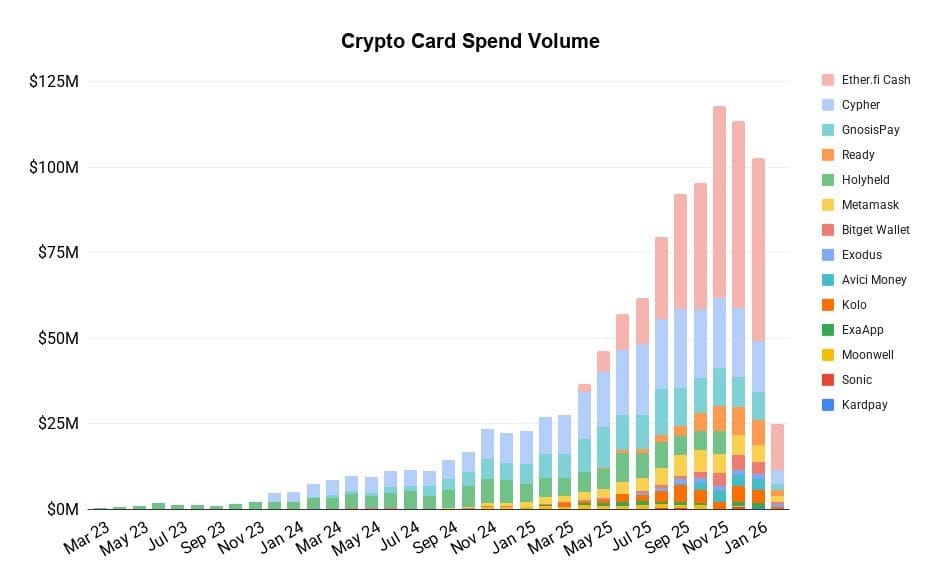
The broader structural shift is significant. For years, the dominant narrative was that blockchain would disintermediate card networks by replacing the 2–3% interchange fee with peer-to-peer crypto transactions. In practice, the opposite is playing out: card networks are becoming the distribution layer for stablecoin-based payments, while stablecoins are replacing not Visa or Mastercard but the bank settlement infrastructure that sits behind them — the issuing banks, correspondent banks, and clearing systems that currently move funds between parties.
Visa and Stripe-owned Bridge recently announced an expansion of their stablecoin-linked card program to over 100 countries, while SoFi and Mastercard struck a separate partnership to enable SoFi's bank-issued stablecoin as a settlement option across Mastercard's global network. Nium's dual-network positioning is a direct response to that competitive dynamic — rather than aligning with one network, it gives clients access to both from a single integration, a meaningful operational advantage for multinationals running card programs across multiple regions.
Nium already issues 38 million card tokens annually across banks, fintechs, and enterprises, giving the stablecoin platform an established base of institutional relationships to cross-sell into. CEO Prajit Nanu said the company's goal is to let enterprises "put stablecoins to work" without building infrastructure themselves — a pitch aimed squarely at the growing cohort of corporate treasury teams sitting on stablecoin balances and looking for practical ways to deploy them.