

Table of Contents
The U.S. Department of the Treasury's Office of Foreign Assets Control (OFAC) has officially removed Tornado Cash, a cryptocurrency mixer that had been blacklisted for its alleged role in facilitating illicit financial activity, from its Specially Designated Nationals (SDN) List. The decision, disclosed in a Treasury filing on Monday as part of the case Van Loon v. Department of the Treasury, follows a ruling in January by the U.S. Court of Appeals for the Fifth Circuit reversing the sanctions previously imposed on Tornado Cash.
One of Tornado Cash's founders, Roman Semenov, however, remains on the SDN list. His listing had the cyber-enabled activities tag removed, but retains the North Korea Sanction tag.
In the press release, the Treasury Department reiterated its concern over state-sponsored cybercrime, particularly from North Korea.
“We remain deeply concerned about the significant state-sponsored hacking and money laundering campaign aimed at stealing, acquiring, and deploying digital assets for the DPRK and the Kim regime,” a Treasury spokesperson said in a statement.
Today marks a huge victory for privacy, open source technology, and immutable, permissionless smart contracts. The U.S. Treasury Department has lifted the sanctions on https://t.co/mfFVsu3OSY and the TORN token: https://t.co/0cNOq5f1HT
— Roman Storm 🇺🇸 🌪️ (@rstormsf) March 21, 2025
A heartfelt thank you to everyone who…
In a statement on Twitter/X, Storm called the decision a "huge victory for privacy, open source technology, and immutable, permissionless smart contracts."
According to Chainalysis, $1.34 billion in cryptocurrency theft last year can be attributed to North Korea state-backed groups, representing 61% of the total amount stolen by all attackers in 2024.
U.S. authorities have linked Lazarus Group, a North Korean hacker group notorious for large-scale crypto attacks and for targeting crypto protocols, to several high-profile cryptocurrency heists.
Last month, a historic $1.5 billion was lost when Dubai-based exchange Bybit suffered a sophisticated hack suspected to be perpetrated by the North Korean group. The amount lost in the Bybit hack alone exceeded the total amount stolen from crypto platforms by North Korea-affiliated attackers in all of 2024.
Underscoring the administration’s dual focus on security and innovation within the digital asset space, Treasury Secretary Scott Bessent said, “Digital assets present enormous opportunities for innovation and value creation for the American people."
“Securing the digital asset industry from abuse by North Korea and other illicit actors is essential to establishing U.S. leadership and ensuring that the American people can benefit from financial innovation and inclusion,” he added.
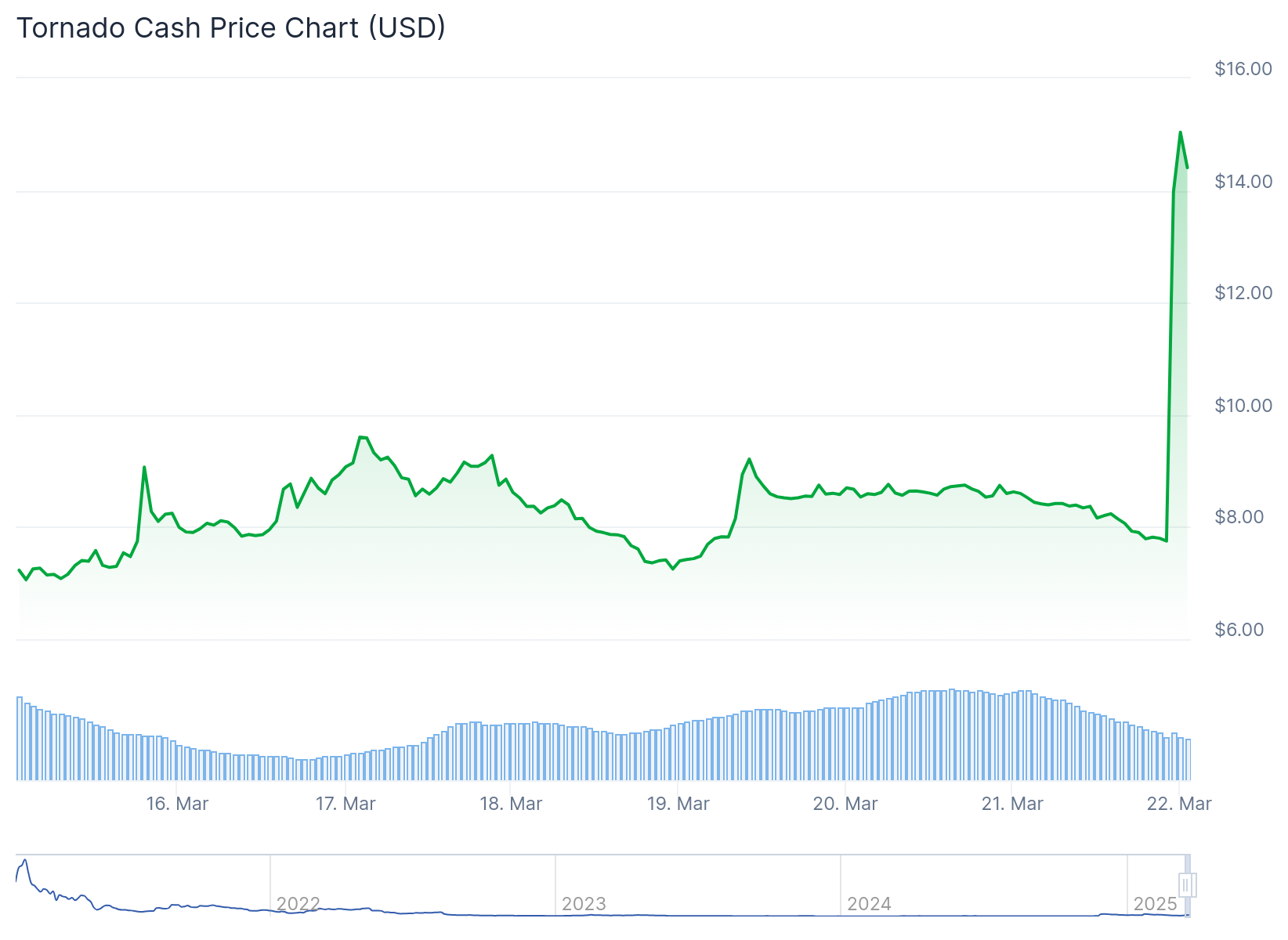
At the time of publishing, the TORN token is up 37.3% to $11.71, retracing some of its gains after climbing by 70% immediately following the ruling.