


Table of Contents
By now, many would have heard the news of the Gallagher brothers reuniting for The Oasis Live’25 tour, which will be held next year in the UK and Ireland. This is also set to be Oasis's first live appearance since the band split in 2009, 16 years after last performing together in Weston Park, Staffordshire, in August 2009.
Coincidentally, it was also some 16 years ago in January 2009 that the Bitcoin network was launched, following the publication of the Bitcoin whitepaper in October 2008. Since that time, the cryptocurrency market has exploded from a single digital currency to a global phenomenon encompassing thousands of cryptocurrencies with a total market capitalization in the trillions of dollars.
The two key factors driving this exponential growth are the dynamic adoption in the Central & Southern Asia and Oceania (CSAO) region, and the role of disciplined investors making solid long-term decisions.
 Blockhead
Slowly Walking Down the Hall, Faster Than a Cannonball
Let’s start with a quick and brief recap of developments in the crypto space over the last 16 years.
On the back of the Global Financial Crisis, which catalysed a growing lack of confidence in the global financial system, a white paper was published in 2008 by Satoshi Nakamoto. In it, a digital currency that is now known as Bitcoin was introduced to the world.
Bitcoin is built on a distributed digital ledger, i.e., a blockchain, a linked body of data comprising units called blocks that contain information pertaining to each transaction, such as date, time, value, buyer/seller, as well as a unique identity code. As entries are set in chronological order, a digital chain of blocks is thus created.
 Blockhead
As a decentralized alternative to the traditional financial construct, Bitcoin facilitates the peer-to-peer buy-sell-exchange process without the need for intermediaries. And Bitcoin in turn has inspired the creation of hundreds of cryptocurrencies all over the world.
Fast forward 16 years, global data and business intelligence platform Statista reports that there are now more than 10,000 cryptocurrencies worldwide as at August 2024, with the top 20 cryptocurrencies reportedly making up nearly 90% of the total market. At the time of writing, the global crypto market cap stood at US$2.05 trillion, with Bitcoin accounting for more than 56% of the entire crypto market cap.

Asia: Definitely, Maybe
According to The 2023 Geography of Cryptocurrency Report by Chainalysis, the CSAO region “hosts what may be the world’s most dynamic and fascinating cryptocurrency market”.
Accounting for factors such as purchasing power and population to measure grassroots adoption, in addition to raw transaction volume, Chainalysis notes of the region’s dominance in its Global Crypto Adoption Index, wherein six of the top 10 countries include India, Vietnam, the Philippines, Indonesia, Pakistan and Thailand.
Elsewhere, Henley & Partners has ranked Singapore first globally in the Henley Crypto Adoption Index 2024, in terms public adoption, infrastructure adoption, innovation and technology, regulatory environment, economic factors and tax-friendliness. Here, it is worth noting that the island city-state is hosting TOKEN2049 in September 2024, for the third time, bringing together decision-makers in the global crypto ecosystem to deliberate, ideate and shape the future.
 Perion Lim
The Singapore Wonderwall
The Singapore Asset Management Survey 2023 released by the Monetary Authority of Singapore (MAS), reveals that Singapore’s assets under management (AUM) grew by 10% to US$4.1 trillion in 2023.
As a base for some 1,250 fund management companies, Singapore is positioned as a key gateway for global asset managers and investors to tap on growth opportunities in the region, with 77% of AUM sourced from outside Singapore, and 89% of AUM invested outside the country.
In 2022, MAS announced the launch of Project Guardian, an initiative seeking to explore the feasibility of applications in asset tokenisation and DeFi while managing risks to financial stability and integrity.
And in June this year, having worked with 24 financial institutions over the past two years, MAS announced the expansion of initiatives to scale asset tokenisation for financial services; this includes partnering with global industry associations and financial institutions to drive common asset tokenisation standards in fixed income, foreign exchange, and asset/wealth management.
 Blockhead
Having successfully completed the first phase of the ‘Global Layer 1’ initiative, the regulator is reportedly now planning to develop standards, market practices, and governing principles for foundational digital infrastructure supporting tokenised assets.
Notwithstanding the above developments, the city-state’s stance toward cryptocurrencies has tightened in recent times, with the intent of protecting the local retail investor. Stricter rules have been introduced for cryptocurrency service providers, in a bid to shepherd business conduct and consumer access measures, and “limit potential consumer harm.”
Such measures include prohibiting crypto service providers in Singapore from accepting locally issued credit card payments, offering incentives to trade in cryptocurrencies and providing financing, margin or leverage transactions for retail customers. Mindful of how crypto prices are subject to volatility and speculation, local authorities continue to warn the general public of the risks entailed in crypto trading.

Slip Inside the Eye of Your Mind When Making Any Investment Decision
The Central Provident Fund (CPF) is a key pillar of Singapore’s social security system, serving as a mandatory social security savings scheme funded by contributions from employers and employees. The principle employed is simple: as an employee works and makes CPF contributions, she/he is able to accumulate savings which are available to be drawn on upon her/his retirement.
As at June 2024, the CPF Board had 4.2 million members and S$583 billion in CPF balances. In view of this large retirement savings pool, there has been increasing chatter on the ground about whether retirement monies could possibly be channeled into crypto investing.
In my interactions with the local investment community, I too have been asked about the notion of including crypto in one’s portfolio. To this end, it should be noted that much has been written about cryptocurrency being a new investment opportunity and the merits of having crypto exposure within a total portfolio context, positioned alongside other traditional assets such as equites, fixed income, commodities and the like.
There is data suggesting that allocating calculated exposure to crypto assets can optimise portfolio returns and risk-adjusted outcomes. Statical analyses notwithstanding, I prefer to slip inside the eye of my mind and ask myself some key questions (many times) before committing any capital into any investment – regardless of asset class or instrument:
- What outcomes are you seeking to achieve with your capital/wealth? To whom do you have a fiduciary duty and who are you accountable to in your decision making?
- Are you looking to invest or trade? (Yes, there is a difference between the two)
- What are your motivations for wanting exposure to a particular asset class/instrument? Are you seeking more beta, alternative alpha sources, better diversification, optionality, a hedge?
- What are your return objectives? Do you know the risks you are undertaking as you seek out such objectives? What kind of risks are you able/ willing/ need to take?
Some might say that the questions above are basic and first order in nature, and indeed they are. But you’ll be surprised to learn how few actually spend the necessary time contemplating them, especially in a FOMO driven world. Let the answers to these ostensibly basic questions facilitate your decision on whether to take that step in putting your money to work in any asset class/instrument, be it equities, cryptocurrencies, art, whiskey or even a rock-and-roll band.
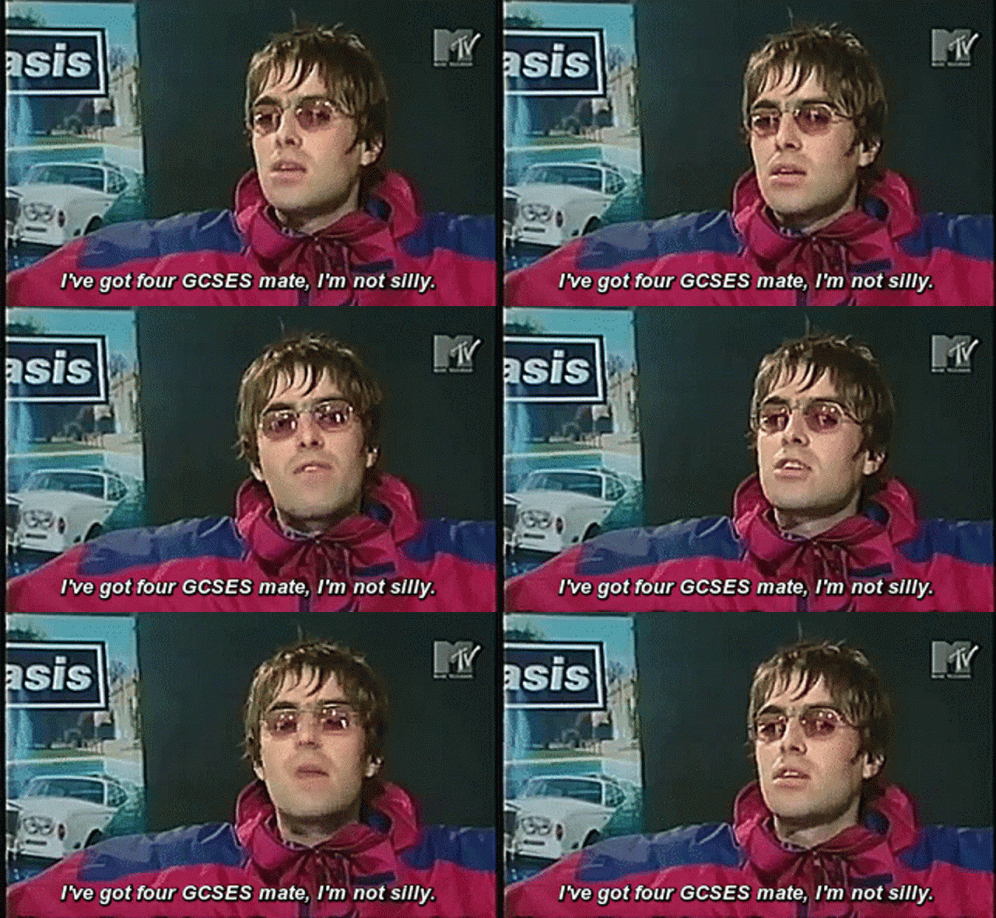
Personally, I continue to abide by a maxim often attributed to legendary investor Peter Lynch: know what you own, and why you own it. After all, there is little point in looking back in anger when an investment decision goes awry, if one had not discerned carefully and conducted the pre-requisite due diligence before taking the plunge. To this end, I couldn’t agree more with the title of one of my dogeared books: successful investing is a process.
What’s The Story Crypto Glory?
As we begin our march towards 4Q2024 and peer beyond the looking glass into 2025, crypto market observers have begun to wonder about the pipeline of catalysts available for the crypto sector rediscover its mojo, particularly given its relatively rangebound year-to-date performance.
Here, there are perhaps a few macro drivers that readily come to mind, including a crypto-themed US elections in November, global central banks embarking on a rate cut cycle, as well as an observable uptick in institutional investors’ desire for digital assets adoption.
 Blockhead
Looking beyond the short term however, perhaps a deeper-level issue worth mulling over pertains to the motivations of players within the crypto ecosystem. And this in turn leads us to consider the perpetual tension between the intent of building a new financial order and the distractions brought about by a speculative, get-rich-quick mentality. This then leads us (back) to the fundamental debate on mindset versus skillset.
It is plain to see that the crypto industry is brimming with talent, comprising individuals with impressive mental prowess, hailing from top tier universities and/or blue-chip investment/trading platforms. While this has certainly inspired the creation of open networks and new infrastructure by those embracing the mission to empower everyone, everywhere, to own crypto with complete trust, we cannot deny that the industry has had its fair share of reckless, foolish characters.
According to a Reuters report, with reference to data from the US FBI, losses from cryptocurrency-related frauds and scams increased 45% in 2023 from a year ago, totaling more than US$5.6 billion.
 Perion Lim
In Search of The Masterplan
For crypto to ascend to its next paradigm and fulfill its intended potential – in search of that champagne supernova vision of a decentralized, autonomous, personalized utopia – perhaps the current crypto market lull can serve as an opportunity for a meaningful reset of mindset and philosophy.
Sure, the skillset is abundant, as discussed previously and evidenced by the sprouting of Web3 firms and their ambitions to empower users with ownership and control. But this alone, as we have come to see, is not enough.
Lessons learnt from the sector’s initial growth spurt, characterized by the speculative chase of cryptocurrency prices going to the moon and the allure of fast value extraction, at the expense of sound governance and due process, serve as a stark reminder (again) that without the fundamental moorings of strategic intent and a purpose-driven values system centered on establishing institutional grade policy and best practice, there is a limit to what skillset and mental acuity alone can bring to the table.
As institutional and mainstream crypto adoption gather pace, those who are considering their next or initial steps into digital assets are demanding to be convinced of crypto’s purpose and function. This demand is likely to only get stronger, backed by the growing call for policy makers and industry players to co-create a masterplan focused on solving real world problems and facilitating our transition into a digital world thriving on multiple networks and continuous enhancements in governance, ethics, transparency and productivity.
Casting our vision further afield, there are certainly reasons to be optimistic; the crypto sector is a complex and thrilling domain that continues to merge with traditional finance, broadening access to new investors and unearthing new growth opportunities.
Personally, I’m already looking forward to 2025 as I prepare to visit Wembley for my first live Oasis concert – 16 years on, but never too late. D'you know what I mean? – yeah, yeah.

Benedict Yap, CFA, is a Senior Vice President and Product Specialist with Sygnum’s Asset Management business. Benedict’s 22-year career in investment management has seen him take on responsibilities including industry development and policy making at the Monetary Authority of Singapore, manager research and selection at the EIM Group and Mercer, being a product specialist for equities and hedge funds at Fullerton Fund Management and being Head of ESG at Singapore-based Lion Global Investors.