


Table of Contents
Hot perp summer was just about over. Or so we thought.
Last Thursday, Ripple threw its hat into the bullring. Ripple Prime, the company's brokerage arm, began offering institutional clients round-the-clock swaps on more than 100 real-world asset markets, from equities to energy to FX, all referencing perps listed on Hyperliquid. It joins a market that traded about $700bn in August alone and barely existed a year ago. That market now spans Hyperliquid, Lighter, Binance, Bybit and OKX, with Kalshi (gold and silver) and Robinhood (in Europe) edging in, plus a few other platforms presumably trying to book Sydney Sweeney as we speak.
Which raises the question: who asked for this? According to JPMorgan, no one. In a June report cited by CoinDesk, the bank said its due diligence found "no/limited institutional demand that our desks are seeing" for perpetual futures. According to Ripple, the answer is Virtu, which is already trading the product. CME chairman and chief executive Terry Duffy is firmly in the JPMorgan camp, telling analysts in July that "we have not heard demand from our customers for these products." That has not stopped CME from suing the CFTC over its approval of rival perps, presumably for failing to regulate competitors Duffy maintains nobody wants.
So is the whole industry an elaborate vehicle for speculation, as some critics claim? Are there any professionals in the room? The data is imperfect, but it points to some interesting patterns.
24/7 or 9-to-5?
Perps offer two advantages over traditional derivatives: A) an indefinite holding period and B) 24/7 trading. The first reduces operational friction for everyone while the second is pitched by Binance as a 'safety net' for traders who don't want to be 'stuck with positions they cannot hedge or adjust'.
In practice, trading on Hyperliquid and Binance follows the TradFi timetable fairly closely. Take Brent crude perps: once traditional markets close on Friday, volume falls to roughly a quarter of its weekday level. Since launch, weekends have accounted for only about 10% to 11% of total volume on both venues. Weekends make up about 29% of the hours in a week, so perp traders use them at roughly a third of the rate a truly round-the-clock market would imply.
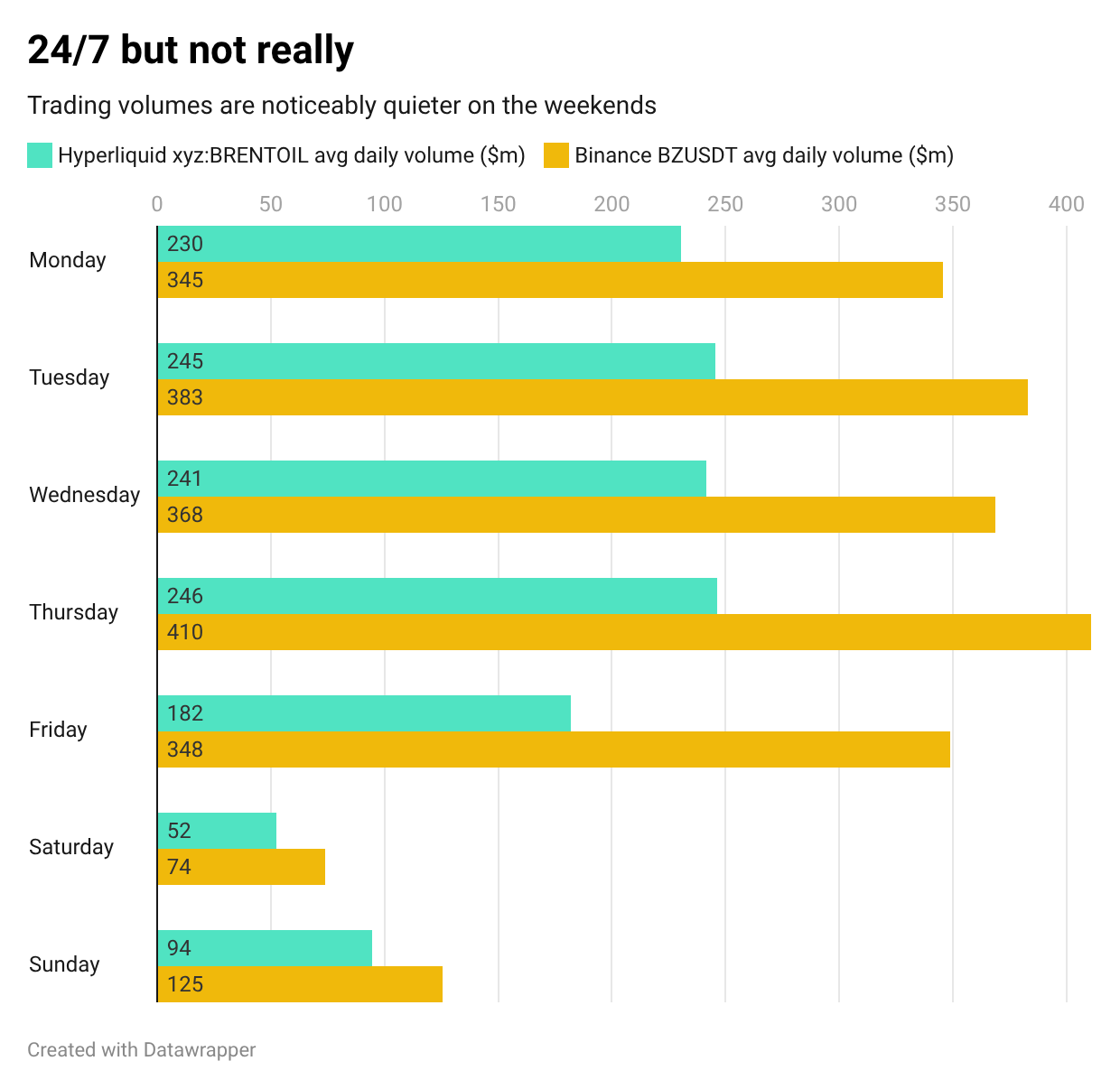
If continuous trading is such delicious catnip for professionals, why aren't more of them using it? For a feature so aggressively marketed, it is strikingly underused.
Iran
The only exception is when the leader of the free world launches an undeclared war that knocks out a large share of the Middle East's oil production, after a promised uprising fails to materialize. In such a hypothetical scenario, you would not want to spend the Saturday fretting about a position you cannot touch.
That is what happened after the US and Israel struck Iran at the end of February, triggering waves of drone retaliation across the Gulf. In the early weeks of the war, when every Truth Social post seemed to signal either the end of the conflict or the end of Persian civilization itself, Hyperliquid's Brent market, which launched in early March, recorded some of its busiest weekends.
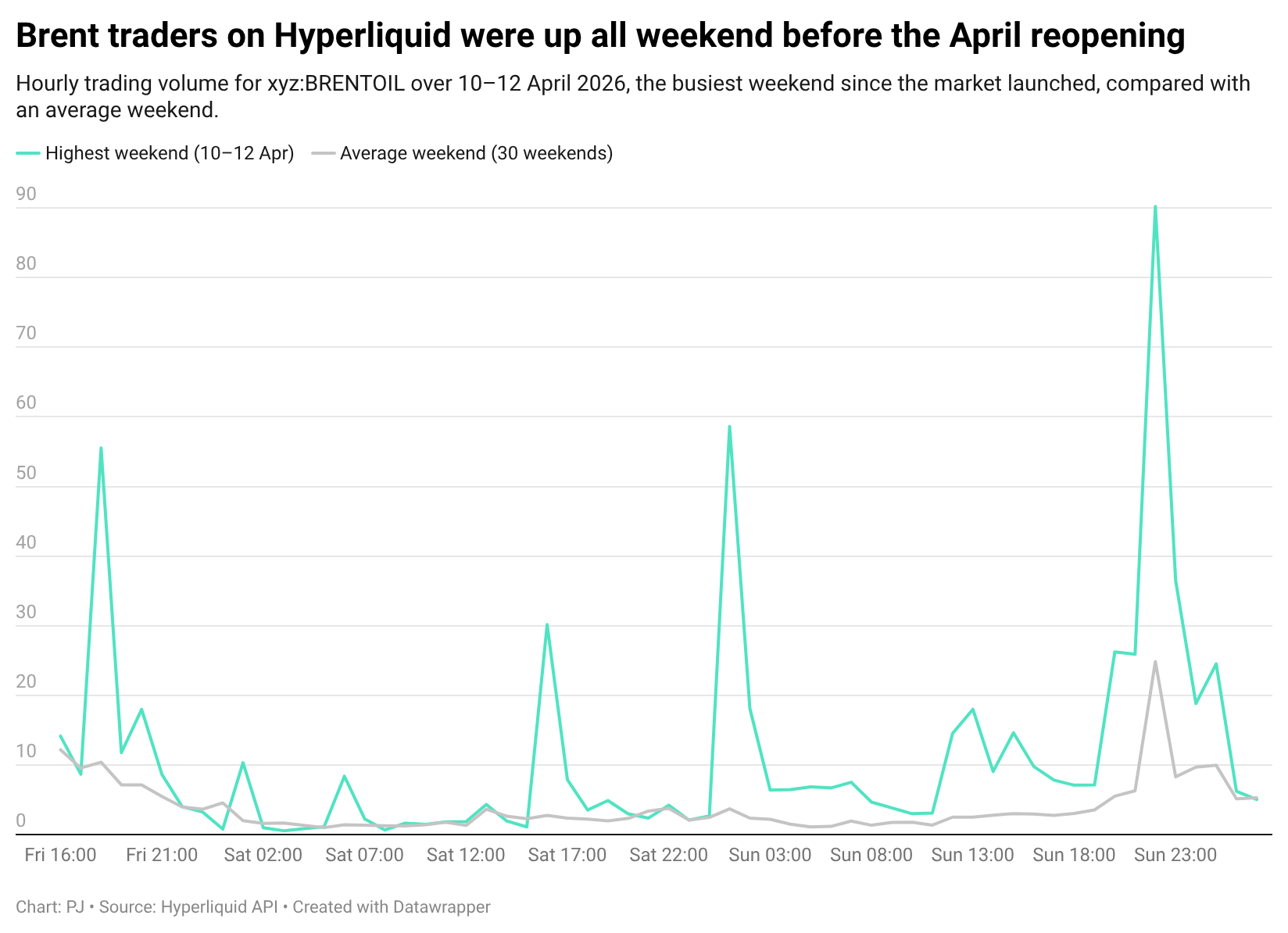
From April 10 to 12, the first weekend after the ceasefire was announced, trading ran at more than three times its usual level, driven by speculation over whether the Strait of Hormuz would reopen to shipping. Most of the busiest weekends in the dataset fall in the opening phase of the war, before markets learned to tune out the noise.
All of this suggests that 24/7 trading has real utility for some, but mainly in exceptional circumstances when no other options are on the table, and as a niche product rather than a replacement. For RWA perps not facing that kind of volatility, 24/7 is that familiar adage: a solution in search of a problem.
An answer in search of a crisis
None of this rules out a future for Ripple Prime, Hyperliquid or their fellow upstarts. Round-the-clock perps may need extraordinary circumstances to prove their worth, but extraordinary circumstances are becoming alarmingly common. If last weekend's riots in France are any guide, it may be wise to keep a position open, just in case of a revolution – and a Sixth Republic.
The bigger challenge is not competition with TradFi but competition against each other. While there's no doubt the perp market is growing, it's not growing fast enough to accommodate all of its new entrants, especially for RWA perps.
For Brent, trading volumes on Hyperliquid have fallen to a third from their $3-4bn peak in early April. Meanwhile, the same instrument on Binance has steadily gained ground over the summer. Weekly volumes are now roughly $1-2bn higher than Hyperliquid and they show no signs of slowing. All signs point to cannibalisation within an crowded perp industry where platforms are starting to outnumber demand.
This is all to say that Ripple will have its work cut out for it. In which case, best give Sydney Sweeney's agent a call before your rivals do.