


Table of Contents
Bitcoin fell below $77,000 over the weekend and remains there after a brief recovery early on Monday.
As investors monitored rising bond rates and surging inflation predictions in the US, Bitcoin dropped drastically from $78,300 during the early May 18 trading to $76,925, down over 1.5 percent in the previous 24 hours amid fresh macroeconomic pressure.
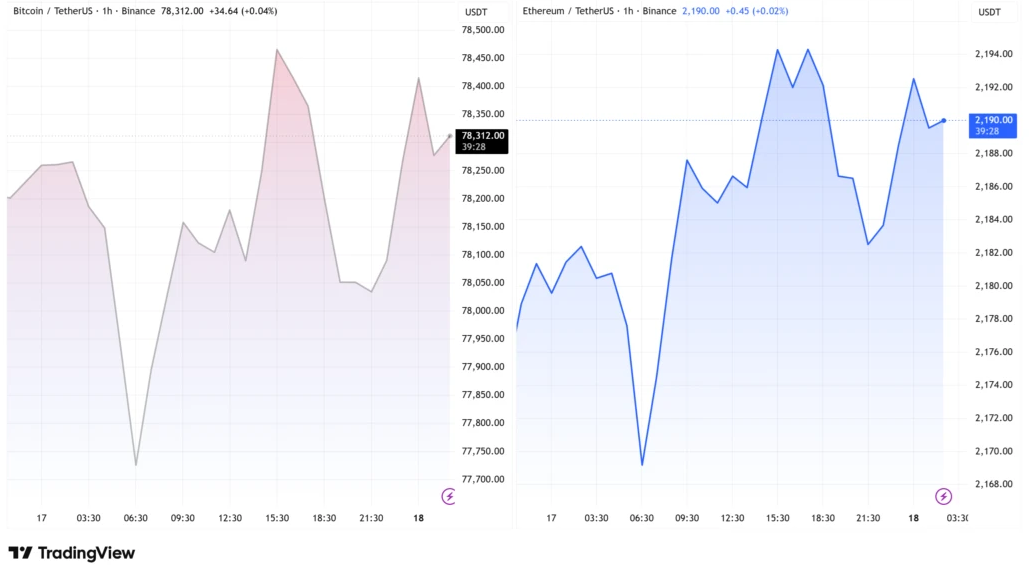
According to new findings from crypto researchers, exchange inflows have increased to levels close to recent highs, indicating that many traders are continuing to participate in the market while taking advantage of profits.
At the same time, financing rates remained positive, suggesting that traders are still inclined towards long positions and expect the trend to continue.
Attention remained focused on the US-China talks. Investors are worried that the markets won't react quickly enough because formal confirmation of agriculture and oil trade agreements is still missing.
Significant derivatives market liquidation activity was also sparked by the price climb down.
Large investors are reducing their holdings, according to recent on-chain statistics, while individual traders are still trying to profit on price drops.
Inflows into exchange-traded funds (ETFs) have slowed due to the recent spike in institutional involvement.
Other major cryptocurrencies followed the cue. CoinDCX data indicates that the top ten alternative cryptocurrencies are holding their ground above critical support levels.
Market mood is currently cautious, as indicated by the drop in the crypto fear and greed index to 39.
Investors are adopting a cautious strategy as Bitcoin stabilizes around the $77,000 level, influenced by rising geopolitical tensions in the Middle East.
After a sustained period of inflows lasting six weeks, Bitcoin ETFs experienced approximately $1 billion in net withdrawals, which has heightened the selling pressure.
Concerns regarding potential disruptions in oil supplies and rising inflation have historically influenced Bitcoin prices, contributing to the Dollar Index's rise to 101.
Investors seem to avoid high-risk tactics in favor of more stable approaches.
For investors to have faith in Bitcoin again, it has to make a solid comeback between $78,000 and $80,000. As long as Bitcoin remains below the $78,000–$80,000 resistance area, one would be careful when placing an entry. A considerable improvement in this band's condition would indicate an increased propensity to take risks.
Currently, the market is going through a strong consolidation phase, and people are responding to market fluctuations less emotionally and more systematically.
There may be a general upturn in the cryptocurrency market sentiment if Bitcoin is able to overcome higher resistance levels.
High Liquidations
The current downturn in the cryptocurrency market has led to a significant increase in liquidations, leaving numerous traders unprepared for the sudden shift.
Liquidations surged by 42% over the past 24 hours, reaching a total of $661 million, with $580 million of that amount coming from long holdings. In the past 24 hours, liquidations of Ethereum positions exceeded $257 million.
In a similar vein, liquidations related to Bitcoin totaling more than $182 million were eliminated during that timeframe. Among the other coins that faced significant liquidation were Solana, Ripple, and Bitcoin Cash. According to the latest data from CoinGlass, 107,275 trades were liquidated in the previous 24 hours.
When crypto exchanges terminate their holdings due to large losses incurred by traders using leverage, this is called a liquidation.
Prices usually fall as a consequence of this selling since it adds more pressure.
Market players still remember well what happened on October 10th, when over 1.5 million people lost a whopping $20 billion.
Many analysts believe this is a major reason why Bitcoin and other cryptocurrencies are struggling.
Surging Bond Yields Weigh
Bond rates throughout the world have recently risen sharply, coinciding with a slump in the Bitcoin market.
Japanese bond rates are at an all-time high, having been steadily climbing for some time. Yields in the US are following a similar pattern and are climbing. According to the latest data, US 30-year bond yields jumped to 5.1%, 2-year bond yields to 4.1%, and 10-year bond yields to 4.6%.
Brent crude oil has risen to $113 per barrel, and WTI has climbed to $110 per barrel, both of which have caused bond rates throughout the world to spike.
In light of the Federal Reserve's expected interest rate hike in the coming months, there is growing concern that this increase may remain in place for the near future. The US headline CPI has increased to 3.8%, while the producer price index has climbed to 6.0%.
When interest rates are high, it might be difficult for Bitcoin and other cryptocurrencies to keep up with the market. Similar patterns are playing out in the stock market, with major Asian indices falling sharply.
The fall in Wall Street futures points to a red open.
Renewed Fears?
The latest decline follows closely on the heels of Bitcoin hitting above $82,000, fueled by significant investments in spot ETFs and positive sentiment regarding the US Clarity Act.
As the focus shifts to U.S. inflation data and changes in Treasury rates, Bitcoin is likely to be strongly tied to broader macroeconomic developments this week.
Also, the crypto industry may benefit from any major developments with the Clarity Act.
The critical level to keep an eye on for Bitcoin is the range of $76,000 to $77,000. The structure's integrity will likely be preserved by a daily closure above. When prices go below this figure, it might be the beginning of a more substantial correction that could aim for a market size of $2.49 trillion.
The subsequent major regulatory event will be the full Senate vote on the CLARITY Act, which is scheduled very soon.
Quickly changing perspectives is possible with a seamless change. Most importantly, we need to know if global tensions will ease up before the vote or if the decline will pick up steam early in the week.
Whale Optimism Differs
A recent on-chain analysis suggests that the Bitcoin market is approaching a crucial phase, driven by the expanding disparity between retail and whale trading activities.
Joao Wedson, a crypto analyst, highlights a clear split between the actions of major Bitcoin market participants and those of individual investors in a post he made on May 16. Data from the Bitcoin: Whale vs. Retail Delta indicator is used to support this claim.
This statistic sheds light on the different trading habits of large Bitcoin holdings compared to individual investors.
By comparing the mood of Bitcoin's major market actors with that of informed capital, we can see if the former is more optimistic or pessimistic.
Bitcoin’s Whale vs Retail Delta has reached its lowest level since January 2024, around the ETF launch, when strong short pressure from whales appeared during a phase of excessive market optimism.
— Joao Wedson (@joao_wedson) May 16, 2026
Now we are seeing a similar behavior pattern.
A large number of people are… pic.twitter.com/ESSjxPd1ND
Wedson points out that the Bitcoin: Whale Vs Retail Delta hit rock bottom in January 2024, right around the time that spot Bitcoin ETFs were launched in the US. During this time, there was obviously a flood of selling pressure from influential Bitcoin stakeholders.
The financial expert has noticed a pattern of behavior that was visible in 2024 and thinks it may come again.
Retail investors are buying Bitcoin at an increasing rate, perhaps thinking that $60,000 is the floor price, while large Bitcoin holders are beginning to reduce their risk exposure, according to market analysis.
It is worth mentioning that during periods of extreme market euphoria, the behavior of huge investors has often signaled the need to exercise prudence.
In the aftermath of large market gains, major players frequently adopt a more aggressive stance towards risk management.
This discrepancy does not, however, necessarily portend an impending price adjustment, as Wedson stresses. But what it really shows is how shaky the Bitcoin market is becoming.
The leading cryptocurrency may face short- to medium-term price pressure if additional variables, including as institutional interest and ETF inflows, combine with the present volatile market.
What Technical Readings Show
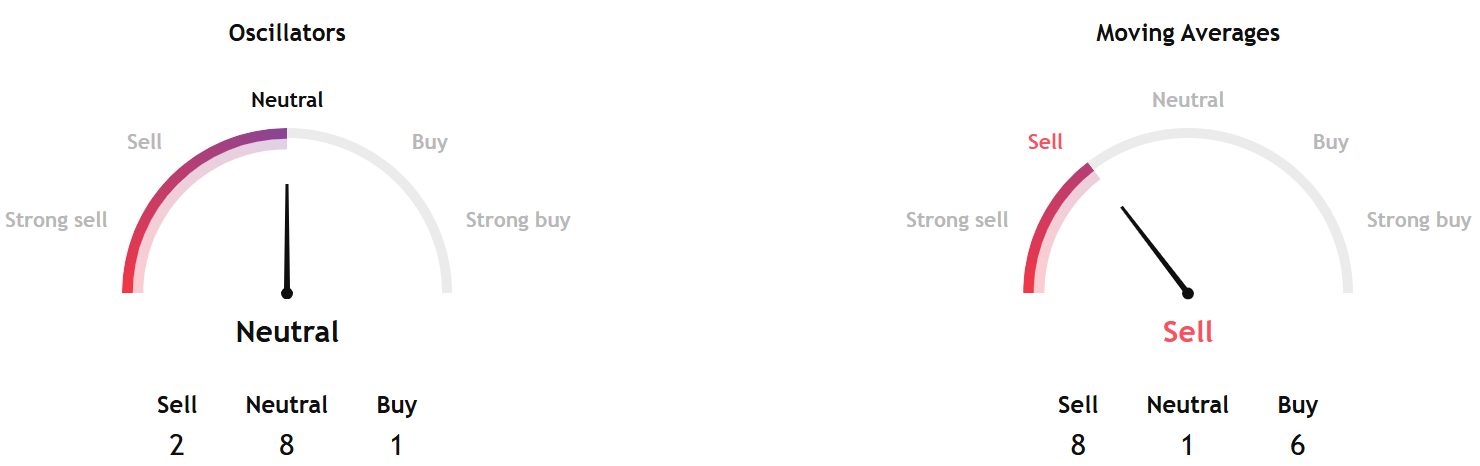
TradingView's technical analysis overview for the coming week, based on key data from moving averages, oscillators, and pivot points, highlights a sell signal.
While the oscillators show a neutral stance, moving averages point to a sell signal.
The recent downturn in the crypto market coincides with a significant increase in outflows from Bitcoin and Ethereum ETFs.
Recent data from SoSoValue indicates that the spot Bitcoin ETFs experienced a decline of more than $1 billion last week.
The situation mirrored that of Ethereum, which experienced a decline in funds for six straight days.
Last week, they experienced a loss exceeding $255 million, resulting in monthly outflows surpassing $83 million.
Declining outflows from Bitcoin and Ethereum ETFs indicate a decrease in demand.
This also indicates that individuals are realizing their profits following the recent upturns.
Separately, InvestTech's Algorithmic Overall Analysis and recommendation for one to six weeks gave a hold signal.
The research said, "Bitcoin has broken the floor of the rising trend channel in the short term, which indicates a weaker initial rising rate."
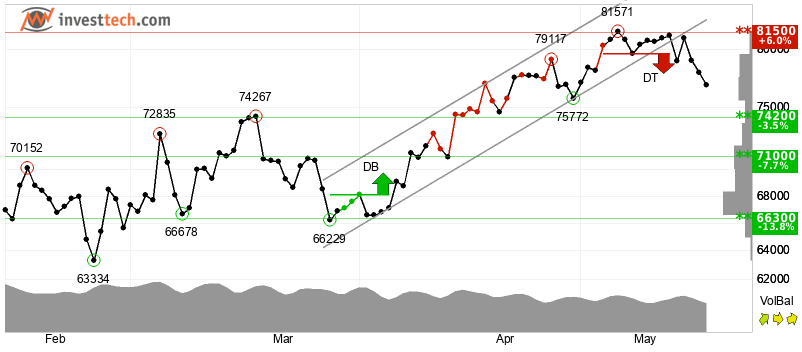
InvestTech added, "The token has support at $74,200 and resistance at $81,500. Bitcoin is assessed as technically slightly positive for the short term."
 Blockhead