

Table of Contents
It's been a rough few weeks for Bitcoin ETF flows. April opened with a $173.7 million outflow on the first trading day of the month. The week ending April 2 managed just $9 million net across the entire product category. Sentiment was, by any measure, in the gutter — the Fear & Greed Index sitting at 11, deep in extreme fear territory.
Then Monday happened.
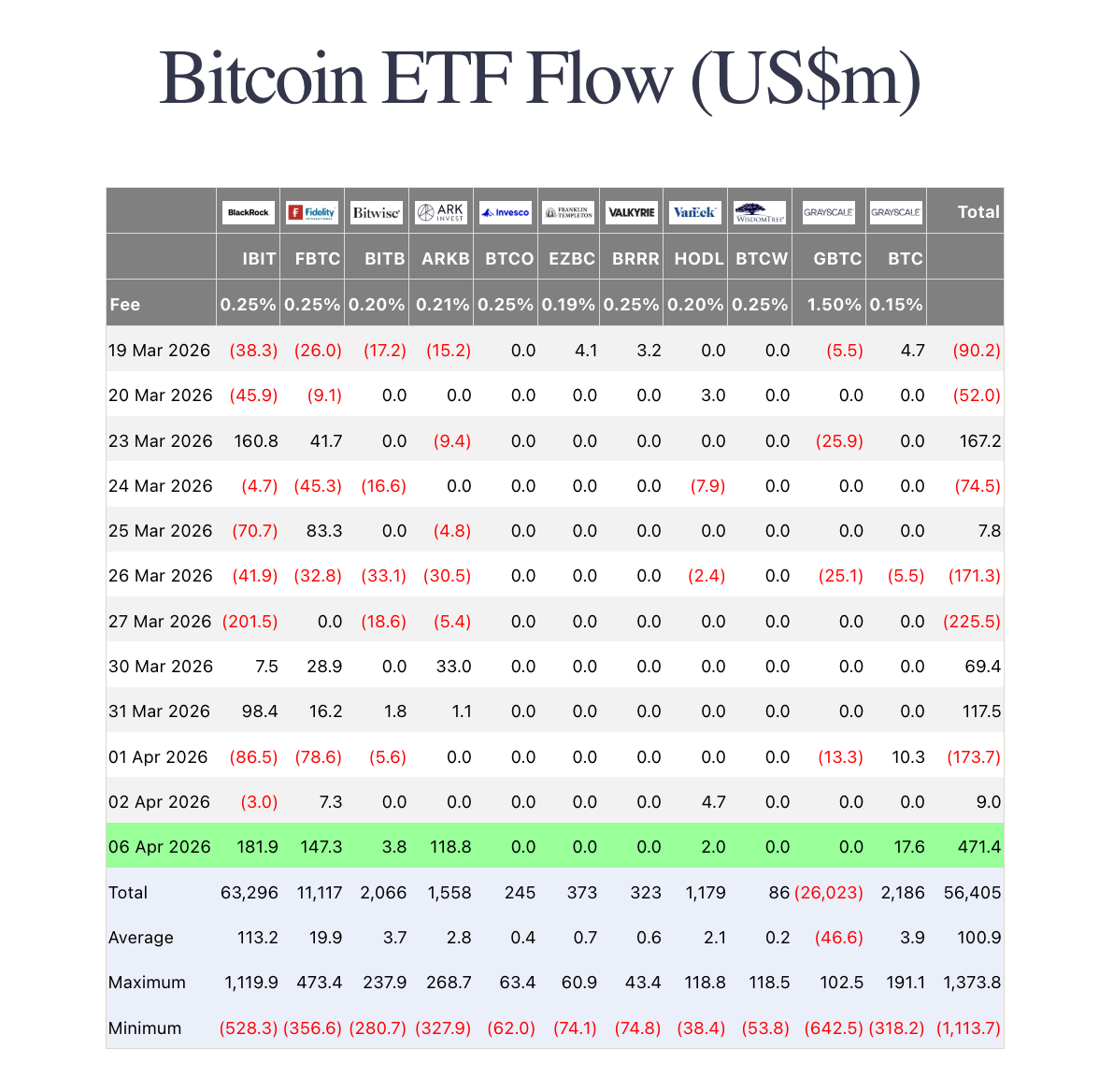
Spot Bitcoin ETFs recorded $471.4 million in net inflows on April 6, per data from Farside Investors. This was the largest single-day total in at least six weeks, and the catalyst had nothing to do with crypto. A Reuters report over the weekend suggested the US and Iran were weighing a ceasefire proposal that would reopen the Strait of Hormuz. Markets exhaled, Nasdaq futures climbed, oil pulled back, and institutional money came rushing back into Bitcoin.
Everyone showed up
Apart from size, the breadth was also notable. BlackRock's IBIT led with $181.9 million, but Fidelity's FBTC wasn't far behind at $147.3 million. Ark's ARKB added another $118.8 million. Grayscale's lower-fee BTC product contributed $17.6 million. Not a single fund posted an outflow on the day.
That kind of across-the-board participation is a different signal than one big player moving a position. It points to coordinated allocation decisions - multiple institutions, multiple mandates, all arriving at the same conclusion on the same morning.
Where prices landed
Bitcoin opened Monday at $68,978, up 2.5% from Sunday, and pushed toward $70,000 through the session. Ethereum jumped over 5%, XRP gained 4%, and Solana added 3%. The total crypto market cap sits around $2.43 trillion, with Bitcoin dominance at 56.6% — a level that reflects investors gravitating toward the market's most liquid asset in an uncertain environment.
But one good day doesn't rewrite the macro story. Fed officials have been clear that inflation remains a concern, and rate cut expectations keep getting pushed back — bad news for risk assets broadly. The $70,000 level Bitcoin is testing has proven stubborn resistance. And the ceasefire report that sparked Monday's rally hasn't translated into a signed deal yet.
If the Middle East headlines turn negative again, flows could reverse just as fast as they came in. That's been the pattern in 2026: institutional money is present but skittish, sensitive to macro signals in a way that crypto markets weren't a few years ago. The ETF era made Bitcoin easier to buy — it also made it easier to sell.
For now though, $471.4 million in a single session is a number worth paying attention to. After weeks of silence, the institutional bid is back on the table.