
Table of Contents
Following Tuesday's approach to the $76,000 barrier, Bitcoin's value fell 7%.
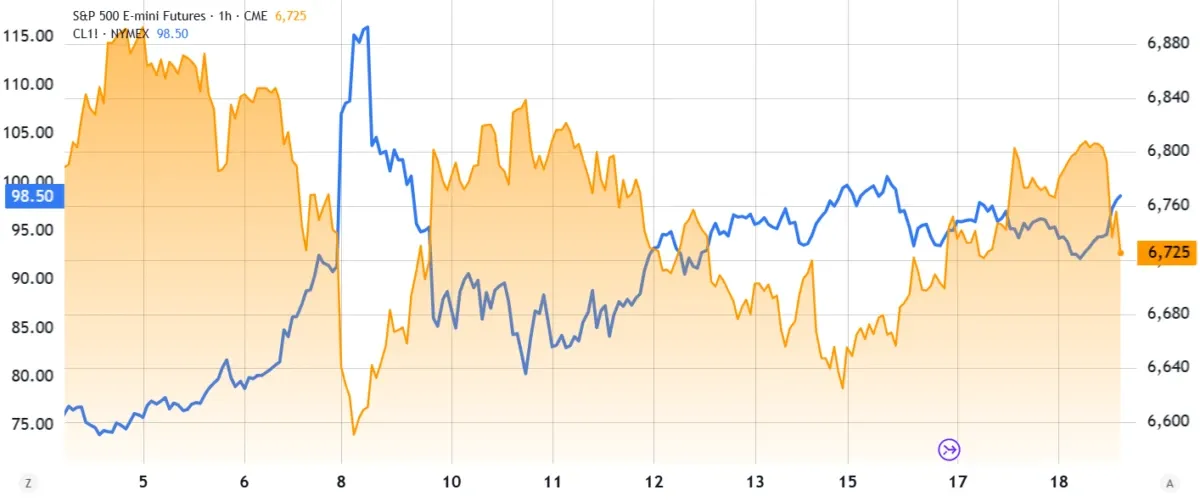
Overnight, the US stock market had fallen due to a combination of factors, including an unexpectedly high US producer price index and a surge in oil prices caused by Israel's strike on Iran's main gas processing plant.
Despite the recent dips, Bitcoin's upward trajectory remains intact.
This is particularly true when compared to the S&P 500 and US Treasuries, which have both been negatively affected by the worsening macroeconomic conditions.
The possibility of cascade liquidations has been reduced since Bitcoin advocates have avoided heavy leverage.
The reaction in crypto was immediate to the Federal Reserve's hawkish hold, and the accompanying statement acknowledges that "uncertainty about the economic outlook remains elevated.
Despite the continual difficulties caused by the Iranian crisis and the recent dismal US employment market data, the S&P 500 index remained only 4% short of its all-time high on Wednesday.
The latest data shows that for the week ending March 7, the number of Americans filing for unemployment benefits stayed at 1.85 million.
Wholesale prices rose 3.4% in February compared to the previous year, according to reports released on Wednesday. This is the biggest annual increase.
Investors are increasingly of the opinion that the US Federal Reserve will continue to implement stringent monetary policies far into 2026, as oil prices continue to rise over $100.
The probability of changing rates by September decreased dramatically to 42% on Wednesday, down from 89% only one month ago, according to the CME FedWatch Tool, which is based on implied odds in the futures markets.
War Risks Bitcoin's Rise Indirectly
A cautious stance among investors has been prompted by persistent inflation and the likelihood of a protracted conflict, both of which have reduced the likelihood of economic measures geared toward growth.
Taking into account the correlation between interest rates and inflation expectations, market players do not appear to be anticipating a forthcoming recession.
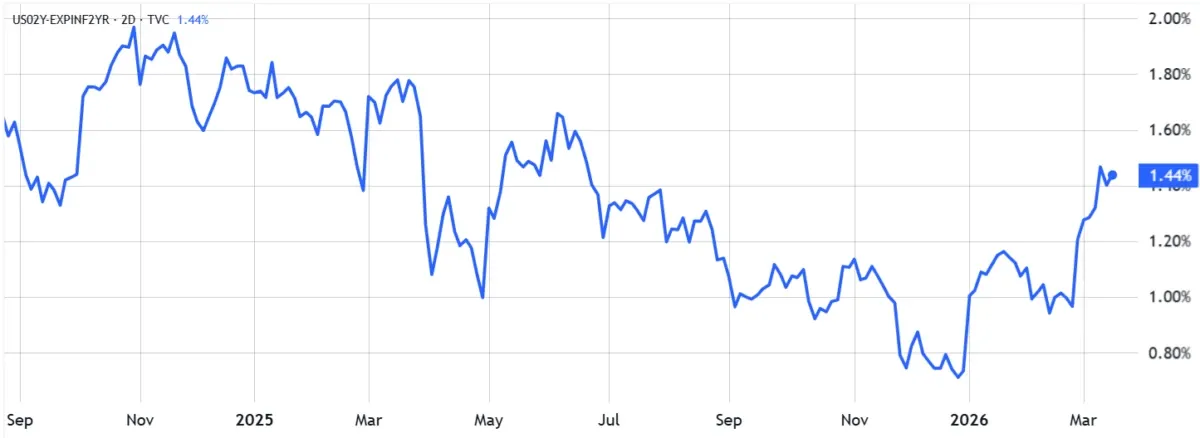
With a 2-year Treasury yield of 3.71% and a 2-year inflation forecast of 2.27% recorded by the Cleveland Fed on Wednesday, an adjusted return of 1.44% was achieved.
Government bond returns are generally negative or almost zero during periods of elevated worry due to the increased demand for these securities. However, the indicator can go up to 2.5% or even more if the US monetary policy remains unpredictable.
There is no danger of a cascade in liquidations, even if Bitcoin falls another 5% in the next few weeks, because optimistic investors are not showing symptoms of increased need for leverage.
Accumulation of US-listed spot Bitcoin ETFs and proactive purchase operations of Strategy (MSTR) have contributed to the current upward trend in the spot market.
According to CoinGlass, leveraged long Bitcoin futures valued at $450 million may be compelled to sell for $68,000 per share, which is less than one percent of the $49 billion in open interest that is currently available.
The financing rate for Bitcoin perpetual futures indicates that short sellers are becoming more confident, as the demand for leverage on these positions is on the rise.
Traders with short positions are financially liable for financing the costs to keep their trades going when the funding rate is negative. Importantly, despite Bitcoin's price rising beyond $76,000, the indicator stayed below the neutral 6% to 12% band.
This lends credence to the notion that momentum is being driven by spot demand and not by speculation in futures markets. After staying over $4,800 for four weeks in a row, gold prices may have become weary, as they dropped to $4,900 on Wednesday.
As concerns about inflation dampen expectations for returns on fixed-income investments, a possible departure from gold may set the stage for a protracted run in Bitcoin.
The present increasing trend in Bitcoin's price shows no indications of abating, in general.
Fed's Non-Action Prompts Crypto Action
The FOMC's statement acknowledged the ongoing robust growth in economic activity, the steady pace of job creation, and the notable rise in inflation rates.
The committee highlighted the significant uncertainty surrounding the economic outlook, noting that the ongoing conflict in the Middle East adds another layer of complexity, with its impact on the US economy still unclear.
Ten of the eleven members who cast ballots favoured keeping the rates as they are.
At the meeting, only Stephen Miran – who wanted a quarter-point cut – spoke out against the plan. It's worth noting that one opposing viewpoint sticks out: the group is clearly divided about when possible rate cuts may take place.
The committee used cautious and thoughtful language. If any threats were detected, it would assess the incoming data and make the appropriate modifications. Going back to 2% inflation is still the target.
The markets were hoping for a clear signal that rate cuts were imminent, but the statement fell short on that front. There were already a lot of obstacles for the market to overcome when the Fed made its comments.
Meanwhile, oil prices soared back above $97 a barrel, and new geopolitical worry spread across the main markets as reports of Israeli strikes on South Pars, Iran's biggest natural gas facility and source of 70% of the country's domestic gas, surfaced.
Both gold and silver experienced price drops; the former fell 2% while the latter fell 2.5%. Someone has been keeping a careful eye on cryptocurrency.
A dramatic shift occurred in just four hours, leading to the liquidation of leveraged long bets worth over $158 million.
What began as a mild correction became a far steeper collapse as a result of this forced selling.
Bitcoin is currently hovering around $71,000, a threshold that experts have pinpointed as essential for short-term market sentiment.
Be at the heart of TradFi–DeFi collaboration at Money20/20 Asia 2026.

Are you looking to forge partnerships with banks and fintechs? To expand into new markets across Asia, or to secure funding from top-tier investors? This April, the world of digital assets, blockchain, and Web3 converges with the biggest players in APAC’s financial ecosystem at Money20/20 Asia 2026 and its brand new ‘Intersection’ zone, complete with a dedicated content stage, TradFi-Defi innovator showcase, and curated networking spaces. From traditional banking giants to decentralised innovators, private equity leaders, and cutting-edge fintech disruptors, this is where they meet to forge partnerships, spark dialogue, and shape the future of finance.