

Table of Contents
The price of Bitcoin remained steady around $67,000 even as crude exploded close to $120 per barrel on Monday, while global stocks declined due to increasing worries among investors about potential disruptions in global oil supply.
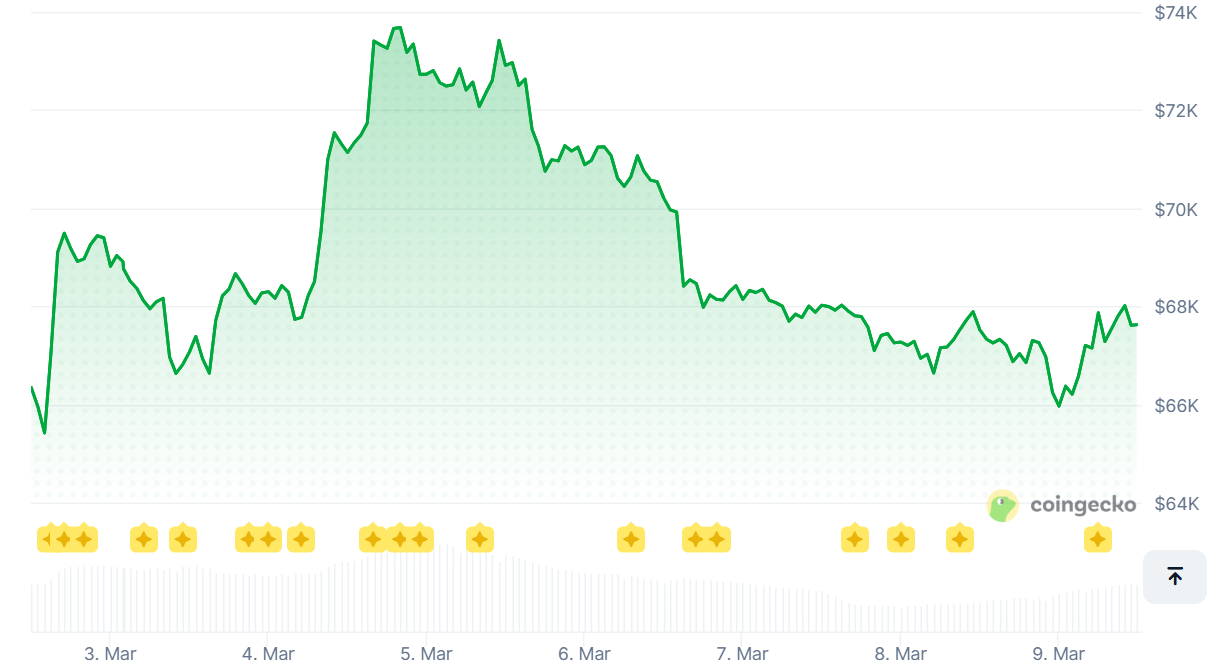
Bitcoin has shown resilience, trading near the $67k mark after revisiting lows of $66k late Sunday when the Middle East war escalated to dangerous proportions.
Over the weekend, hostilities soared in the region, with Israel launching unrelenting air strikes on Tehran and Iran accusing the US-Israel of war crimes, claiming hits to energy infrastructure and desalination plants.
Meanwhile, Iran appointed the late Ali Khamenei's son as the Islamic Republic's supreme leader.
That directly defies US President Trump's plan to have a say in who is chosen as Iran's leadership. In addition, the appointment of a hard-line Islamic leader suggests no change in Iran's stand and worries of more escalation in the ongoing war.
Although the leading cryptocurrency has recovered from its recent dip, it has given up all the gains achieved last week when Bitcoin rose to $74,000. Its recent downturn reflects trends seen in the equity markets, as global stocks dropped significantly, signalling a challenging start to the week, particularly in light of soaring oil prices.
Crude is now up over 90% from December lows, suggesting the risk of higher global inflation is a reality rather than just pessimistic bets.
Due to rising oil costs and a general lack of confidence in the market, Bitcoin fell by as much as 2% in Monday's early Asian trade, reaching $65,500. But in a matter of hours, Bitcoin was back above $67,500 after falling to a one-week low as opportunistic buyers intervened.
With a cautious approach prevailing, investors are withdrawing funds from high-risk assets and reallocating them into more stable options.
Typically, Bitcoin experiences significant downturns during these events. Ultimately, it carries a degree of risk.
In early trading on Monday, oil prices surged beyond $115, with analysts indicating a possible increase to $150 a barrel due to the ongoing conflict in Iran.
The soaring oil prices are causing concerns about their effect on the US economy, which may influence the short-term performance of various risk assets.
Monday's modest 2% decline in Bitcoin, in contrast to the 7% selloffs seen in Asian stocks, suggests a more nuanced narrative for the top crypto token.
The surge in Brent crude reaching $120 a barrel for the first time since June 2022 served as the driving force for risk-off bets. The price of US crude has surged over 27%, now exceeding $116 per barrel.
This marks the initial occasion that US oil prices have surpassed the $100 threshold since the onset of the conflict in Ukraine in 2022. At the beginning of 2026, it was significant to observe that US oil prices remained under $60 per barrel.
The increase occurs as major producers reduce production in response to the intensifying conflict in Iran. When oil experiences such a sharp increase, concerns about inflation rise correspondingly, leading traders to minimize their involvement in speculative assets.
Still, Bitcoin has demonstrated its resilience in challenging conditions, outperforming many others.
Clean Positioning?
Cryptos' subdued response in relation to Wall Street bets and global stock benchmarks suggests that the majority of leveraged long positions may have already been effectively eliminated from the market.
The absence of leverage eliminates the risk of forced selling, and without the fire sale, there is no risk of a cascading effect.
Taking a long position in an asset's value appreciation while using borrowed money is known as a leveraged long position. When prices fall, middlemen force sellers to close their positions, which increases selling pressure and makes the price drop even worse.
It is encouraging to see that Bitcoin is not trapped in that doom spiral now.
The current holder base appears to consist of individuals who invested their own funds and are not under pressure from borrowed capital. Steady capital often remains resilient. Rushed decisions with borrowed funds are not advisable.
The war in the Middle East has pushed top crude suppliers like Iraq, UAE and Kuwait to reduce production in light of the ongoing tensions in the Strait of Hormuz.
The current situation reflects a significant disruption in oil supply, with a daily decrease exceeding 20 million barrels.
However, Trump described the surge in oil as a “small price” to pay for peace.
Trump, in a Truth Social post, noted, "Temporary oil price hikes are a small price for US and world security. Prices will drop fast once Iran’s nuclear threat is gone. Only fools think otherwise."
What Next?
Bitcoin may experience a decline, potentially reaching year-to-date lows in tandem with the stock market. Experts have previously identified $50,000 as a significant threshold.
The upcoming developments globally may significantly influence the immediate price movements of Bitcoin.
Resilience in the face of the Iran conflict and concerns stemming from oil market fluctuations could pave the way for a period of stabilization.
Last week, there was a noticeable uptick in institutional interest, as evidenced by ETF inflows, which totalled $568 million from March 2 to March 6.
Overall, the market has rebounded from recent withdrawals, with inflows making a notable impact.
A wider narrative surrounding "digital gold" also frames BTC as a safeguard against the erosion of fiat currency, particularly as rising oil prices pose risks to global inflation.
In this scenario, the price may recover to exceed $70k and aim for the $75k-$80k range.
Nevertheless, the route with the least friction seems to trend downward as market participants reflect on the international geopolitical strains.
Conversely, $64,000 serves as the initial support level to monitor. A decisive move below that level could pave the way to $61,000, marking the next significant support level.
On the positive side, $68,000 serves as the immediate resistance level, indicating the price point where sellers have historically intervened to limit upward movements. A decisive breakthrough above $68,000 would significantly alter the short-term momentum landscape.
Bets Surge for a Wall Street Crash
Financial experts are sounding the alarm about possible bigger economic dangers in light of the historic oil crisis caused by the closing of the Strait of Hormuz.
The probability of a US market slump has risen from 20% early this year to 35% according to experts.
At the same time, the probability of a strong crypto market rally is pegged at 5%.
Rising oil prices are contributing to increasing inflation, while the pace of economic growth in the United States is experiencing a slowdown.
This could impact both stocks and cryptocurrencies.
What Do Technical Readings Show?
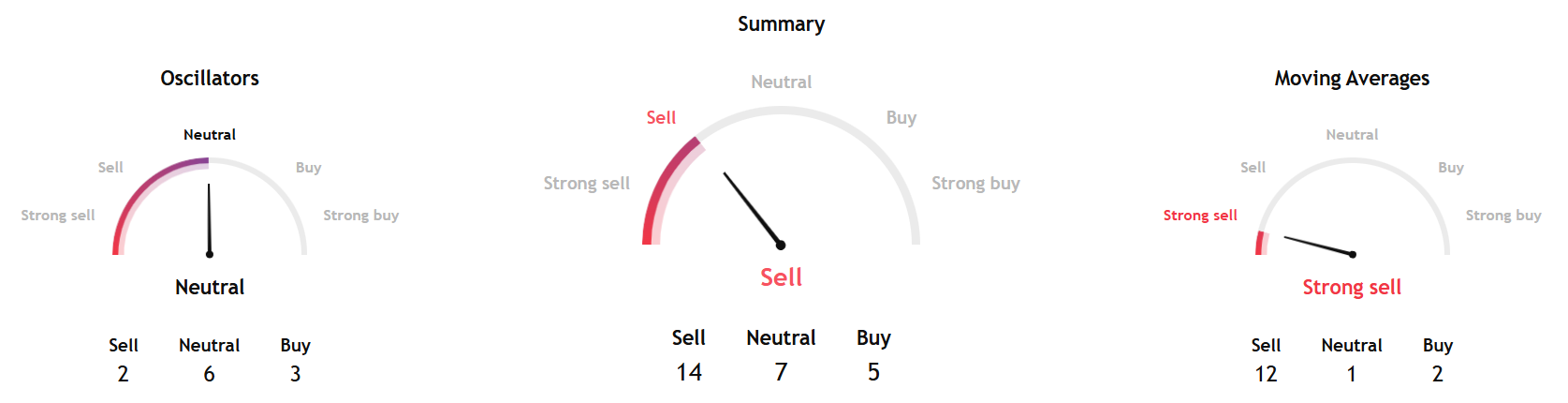
TradingView's technical analysis overview based on key data from moving averages, oscillators, and pivots for the week ahead still signals a sell bias.
However, the Oscillators indicators show a neutral reading.
Separately, InvestTech's Algorithmic Overall Analysis and the recommendation for one to six weeks gave a negative score.
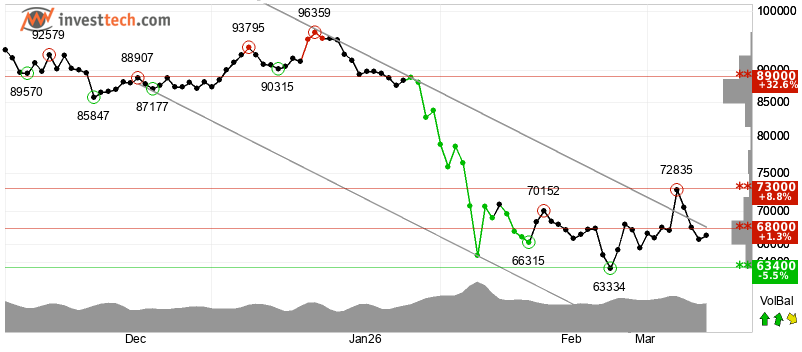
InvestTech said, "Investors have accepted lower prices over time to get out of Bitcoin, and the currency is in a falling trend channel in the short term. Falling trends indicate that the token experiences negative development and falling buy interest among investors. Bitcoin has broken through support at $68,000. This predicts a further decline.
The research firm added, "The volume balance is positive and strengthens the token in the short term. RSI diverges positively against the price, which indicates a possibility for a reaction up. Bitcoin is overall assessed as technically negative for the short term."
Blockcast – Licensed to Shill: Designing Decentralization: Governance, Power, and the Validator Problem
This episode examines what happens when decentralization moves from whitepaper language to operational reality. Tanisha Katara joins the discussion to unpack three structural tensions inside modern crypto governance: validator power concentration, voter apathy, and the emerging role of AI agents in decision-making systems.
If you enjoyed this episode, please like and subscribe to Blockcast on your favorite podcast platforms like Spotify and Apple.
Blockcast is hosted by Head of APAC at Ledger, Takatoshi Shibayama. Previous episodes of Blockcast can be found here, with guests like Fredrick Gregaard (Cardano Foundation), Daren Guo (Reap), Yat Siu (Animoca Brands), Kean Gilbert (Lido), Joey Isaacson (Nook), Kapil Dhiman (Quranium) Eric van Miltenburg (Ripple), Davide Menegaldo (Neon EVM), Anastasia Plotnikova (Fideum), Jeremy Tan (Singapore parliament candidate), Hassan Ahmed (Coinbase) and more on our recent shows.
Be at the heart of TradFi–DeFi collaboration at Money20/20 Asia 2026.

Are you looking to forge partnerships with banks and fintechs? To expand into new markets across Asia, or to secure funding from top-tier investors? This April, the world of digital assets, blockchain, and Web3 converges with the biggest players in APAC’s financial ecosystem at Money20/20 Asia 2026 and its brand new ‘Intersection’ zone, complete with a dedicated content stage, TradFi-Defi innovator showcase, and curated networking spaces. From traditional banking giants to decentralised innovators, private equity leaders, and cutting-edge fintech disruptors, this is where they meet to forge partnerships, spark dialogue, and shape the future of finance.