


Table of Contents
Circle shares have rallied nearly 50% in less than two sessions following the USDC issuer's fourth-quarter results, but analysts say the move reflects crowded positioning rather than a fundamental re-rating.
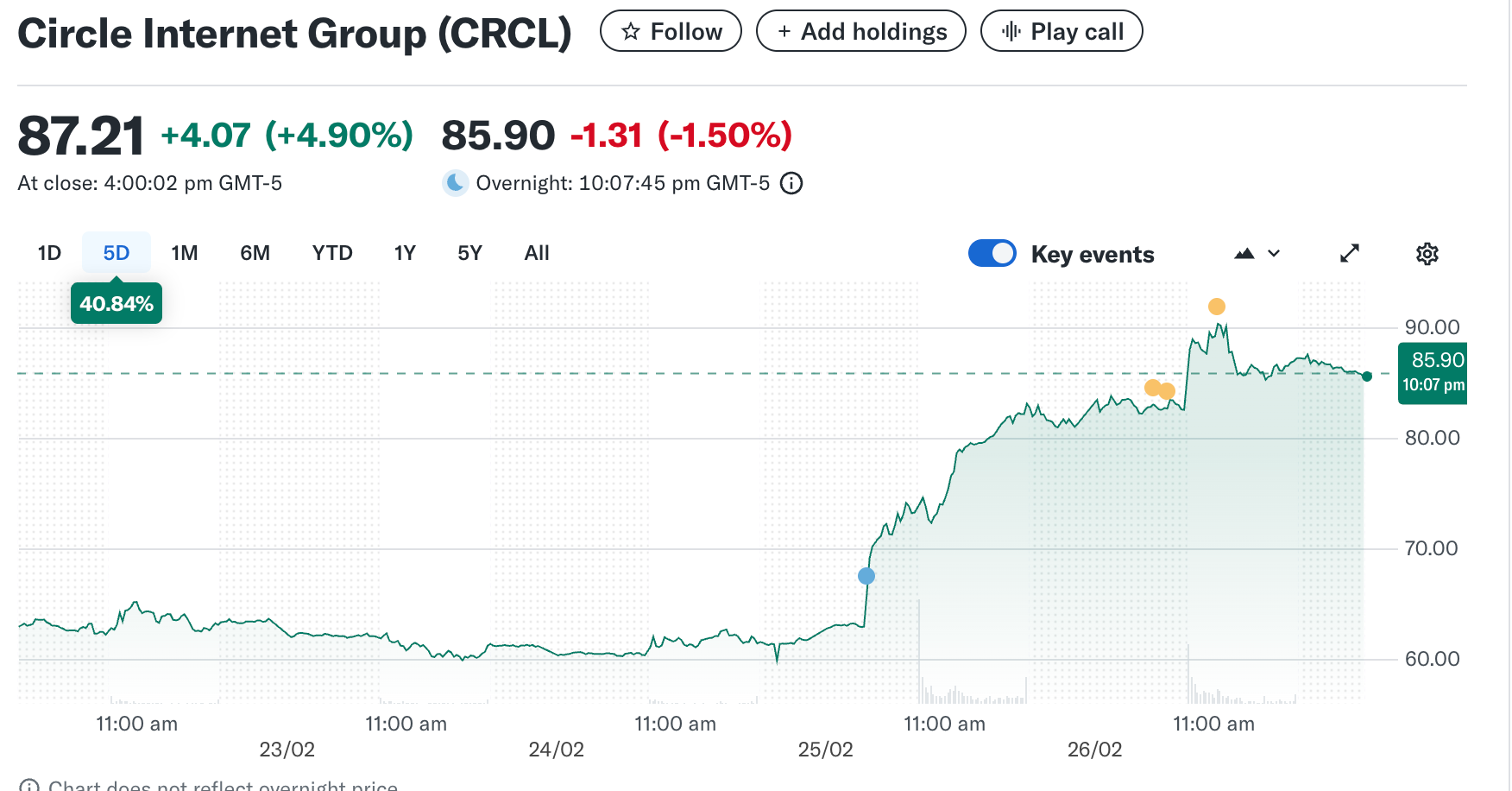
The violent reversal snapped an 80% drawdown from record highs hit last year, leaving short sellers nursing an estimated $500 million in single-day losses.
The size of the move wasn’t simply a reaction to the headline data. What really fueled it was how investors were positioned beforehand. Many hedge funds had gone into the release with sizable bearish bets, so when the news hit, they were forced to cover those shorts. That dynamic created a sharp short squeeze, amplifying the rally, rather than signaling a genuine shift in the asset’s underlying fundamentals.
The numbers
Circle reported fourth-quarter adjusted earnings of 43 cents per share on revenue of $770 million, topping analyst estimates on both metrics. USDC circulation reached $75.3 billion, up 72% year over year — outpacing rival Tether's growth rate.
But profitability deteriorated. Distribution costs climbed 66% to $1.66 billion as Circle paid partners and platforms to drive adoption. The company swung from a $156 million net profit in 2024 to a $70 million loss for 2025.
"Stablecoin may be scaling; stablecoin issuance is a tough business," noted Harvey Li of Tokenization Insight.
The bull case
Despite the margin pressure, Mizuho raised its price target on Circle to $90 from $77, citing growth drivers including prediction markets and "agentic commerce" — the emerging use case of AI agents transacting autonomously using stablecoins.
Management highlighted Polymarket and other prediction platforms as meaningful contributors to recent USDC growth, pointing to their high-frequency transaction flows. The company also positioned USDC as a potential default currency for AI agents operating across digital marketplaces.
Mizuho analysts Dan Dolev and Alexander Jenkins forecast average USDC circulation of roughly $123 billion in 2027, with reserve income of $3.7 billion and EBITDA of $916 million — though they maintained a neutral rating, warning that lower interest rates could weigh on reserve income.
The reality check
Circle's business model remains tethered to interest rates. The company earns yield on the Treasury reserves backing USDC, meaning rate cuts directly compress margins. With the Fed signaling potential easing later this year, that overhang persists.
The stock's 50% surge also came from deeply depressed levels. Even after the rally, shares trade well below their 2025 peaks, and the company still faces questions about long-term profitability in a competitive stablecoin market.
For investors who caught the squeeze, the timing was fortunate. For those evaluating Circle's fundamentals, the verdict remains out.